


Overview
In today’s rapidly evolving industrial landscape, customized industrial cooling solutions play a pivotal role in maintaining optimal production environments. Each manufacturing process has distinct thermal management requirements, making a one-size-fits-all cooling system inadequate for many industries. Tailoring cooling solutions to specific production conditions ensures enhanced efficiency, reliability, and longevity of equipment.
Industrial cooling solutions are designed to remove excess heat generated during manufacturing processes, preserving product quality and safeguarding sensitive machinery. These systems range from simple refrigeration units to complex temperature control systems integrated within large-scale plants. Customized designs allow companies to address unique challenges such as space constraints, varying load demands, and environmental regulations.
With over 55 years of experience in the field, companies like Frimec have pioneered tailor-made refrigeration systems that meet the stringent demands of diverse sectors including plastics, chemical, packaging, and more. Their expertise highlights the importance of aligning cooling system design with the specific production cooling needs of their clients to optimize performance and energy consumption.
“Tailor-made industrial cooling solutions are essential for sustaining productivity and product integrity in specialized manufacturing processes.”
By integrating advanced technologies such as air chillers, free cooling systems, and microchillers, modern industrial cooling solutions are not only more efficient but also environmentally friendly. These innovations contribute to reducing operational costs and minimizing ecological footprints, which is increasingly crucial in today’s industrial regulations.

Importance of Tailor-Made Cooling
The significance of tailor-made refrigeration stems from the unique thermal and environmental demands of each industrial process. Standardized cooling units may fail to deliver precise temperature control or adapt to fluctuating production cycles, leading to inefficiencies or equipment failures. Customized industrial cooling addresses these challenges by designing systems that perfectly fit operational parameters.
Customized industrial cooling solutions provide several key benefits:
-
Precision temperature control: Essential for processes sensitive to even slight temperature variations to ensure quality and consistency.
-
Energy efficiency: Systems optimized for specific loads reduce unnecessary power consumption, lowering operational costs.
-
Space and integration: Custom designs accommodate facility layouts and integrate seamlessly with existing equipment.
-
Environmental compliance: Tailored systems can incorporate eco-friendly refrigerants and technologies to meet local regulations.
-
Enhanced reliability: Designed with the exact application in mind, reducing downtime and maintenance frequency.
In industries such as pharmaceuticals or food and beverage, maintaining exact temperatures is critical to product safety and regulatory compliance. Tailored systems provide the control and flexibility necessary to meet these standards reliably. Moreover, in heavy industries like diecasting or galvanic applications, robust cooling solutions are vital to protecting expensive machinery from thermal damage.
“Investing in tailor-made cooling systems is investing in the long-term stability and sustainability of industrial production.”
In essence, production cooling needs vary greatly, and addressing them with customized solutions ensures operational excellence, environmental responsibility, and cost-effectiveness.
Design Process
The foundation of effective industrial cooling solutions lies in a comprehensive and collaborative design process. This process begins with a thorough analysis of the client’s specific production cooling needs, including heat load calculations, space constraints, environmental conditions, and integration requirements.
The design journey typically involves the following key stages:
-
Initial consultation: Understanding the production environment, existing cooling infrastructure, and specific challenges.
-
Thermal load assessment: Precise calculation of heat generated by machinery or processes to determine the cooling capacity required.
-
System conceptualization: Selecting the most suitable cooling technology (e.g., air-cooled chillers, water-cooled systems, free cooling) and preliminary layout planning.
-
Customization and engineering: Developing detailed system designs tailored to client specifications, including control strategies and integration with automation systems.
-
Prototype and testing: When applicable, initial models are tested to validate performance under expected conditions.
-
Implementation planning: Scheduling installation, commissioning, and training for operational teams.
Throughout this process, continuous collaboration between engineers, project managers, and the client is essential to ensure the final product meets all operational criteria. Emphasis is placed on reliability, energy efficiency, and environmental compliance.
“A meticulous design process ensures that customized cooling systems not only meet but exceed production demands while optimizing energy use.”
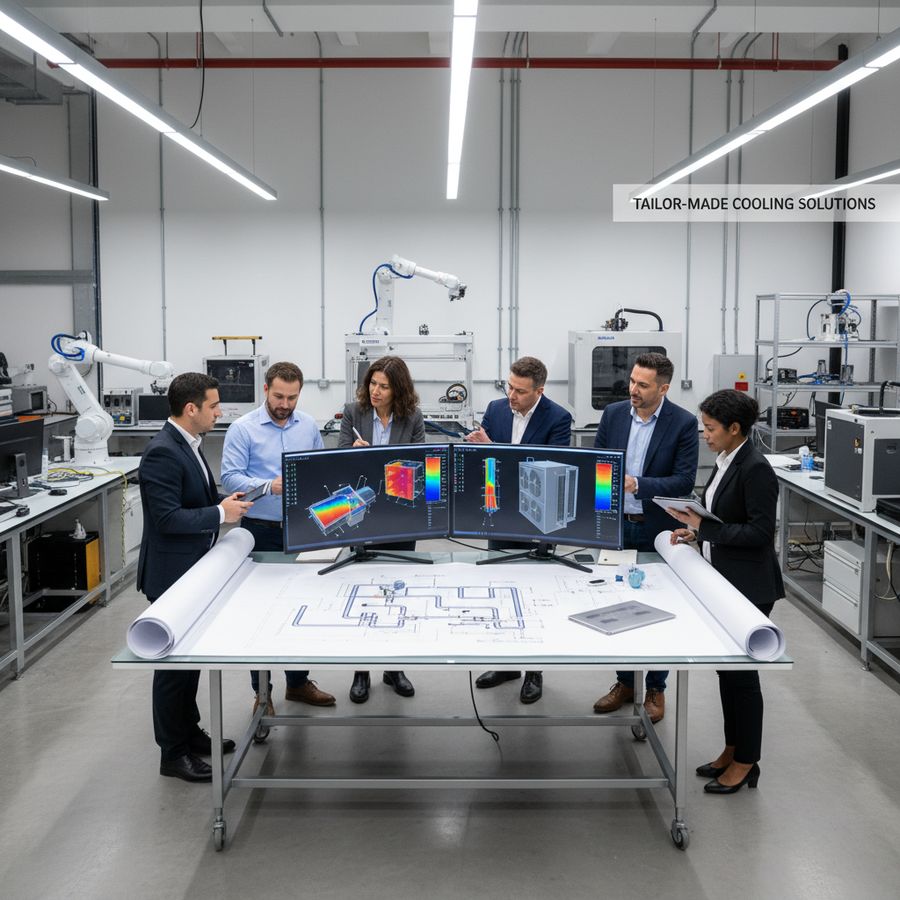
Leading providers leverage advanced software for thermal simulations and system modeling, which helps predict performance and identify potential issues before installation. This proactive approach minimizes surprises and reduces project timelines, ultimately delivering a robust cooling system that precisely fits the unique industrial context.
Technology Options
When creating customized industrial cooling solutions, selecting the right technology is crucial to meeting production cooling needs efficiently and sustainably. Several advanced options are available, each with distinct benefits:
-
Air Chillers: These units use ambient air to dissipate heat and are ideal for facilities with limited water availability or where water conservation is a priority. Modern air chillers offer high efficiency and are easy to install.
-
Water-Cooled Refrigeration Units: Offering superior cooling capacity and efficiency, water-cooled systems are suitable for large-scale industrial applications where water resources are readily available.
-
Free Cooling Systems: These systems utilize low outdoor temperatures during certain seasons to reduce refrigeration loads, significantly cutting energy consumption and operational costs.
-
Microchillers and Thermo Chillers: Compact units designed for precise temperature control in smaller or specialized production areas, providing flexibility and scalability.
-
Cooling Towers: Often used in conjunction with water-cooled chillers, cooling towers enhance heat rejection and improve overall system efficiency.
The choice among these technologies depends on factors such as facility size, climate conditions, production cycle variability, and environmental regulations. Many state-of-the-art systems now incorporate smart controls and IoT connectivity to optimize performance dynamically and enable remote monitoring.
“Integrating the right cooling technology tailored to specific industrial demands is key to achieving operational efficiency and sustainability.”
Advanced refrigerants with low global warming potential (GWP) are also increasingly used in tailor-made refrigeration systems to reduce environmental impact. By combining these technologies thoughtfully, industrial facilities can achieve a perfect balance between performance, cost, and ecological responsibility.
Industry Examples
The versatility of customized industrial cooling solutions is demonstrated across a wide range of industries, each with distinct production cooling needs:
-
Plastic Materials: Precise cooling is essential to maintain dimensional stability and surface finish in plastic molding processes. Customized chillers ensure rapid heat removal to prevent defects.
-
Chemical Industry: Temperature control is critical for reaction stability, safety, and product quality. Tailor-made systems handle aggressive environments and variable thermal loads.
-
Packaging: Cooling solutions support rapid product handling and preservation, often requiring compact and flexible units to fit production lines.
-
Enological (Wine Production): Maintaining specific fermentation temperatures is pivotal. Customized cooling ensures product consistency and protects delicate flavors.
-
Machine Tools and Diecasting: These industries generate substantial heat during operation. High-capacity cooling units prevent overheating and extend equipment life.
-
Galvanic and Laser Applications: Precise temperature regulation enhances process accuracy and protects sensitive components from thermal stress.
“Tailor-made refrigeration systems empower diverse industries to maintain stringent quality standards and optimize operational efficiency.”
By adapting cooling system design to the unique demands of each sector, providers like Frimec deliver solutions that integrate seamlessly into production workflows, enhancing reliability and reducing energy consumption. Such industry-specific expertise is invaluable for companies seeking to future-proof their operations while meeting evolving regulatory and market demands.
Support and Maintenance
Effective support and maintenance are vital components of any customized industrial cooling system’s lifecycle. After installation, ongoing service ensures systems operate at peak efficiency, minimizing downtime and prolonging equipment life.
Leading industrial refrigeration providers offer comprehensive support services including:
-
Scheduled Maintenance: Regular inspections and servicing prevent unexpected failures and optimize system performance.
-
Technical Support: Access to qualified personnel for troubleshooting, system upgrades, and emergency repairs.
-
Training and Commissioning: Ensuring operational staff are fully trained to handle the system safely and efficiently.
-
Spare Parts Availability: Rapid access to genuine components reduces repair times and maintains system integrity.
-
Remote Monitoring: Some systems incorporate IoT technology enabling proactive diagnostics and performance adjustments from afar.
“Consistent support and expert maintenance are essential to maximize the return on investment in customized cooling systems.”
By partnering with experienced service providers, industrial facilities can enjoy peace of mind knowing their tailor-made refrigeration and cooling systems will continue to meet evolving production demands reliably. This ongoing relationship is a cornerstone of sustainable industrial operations.
Conclusion
Customized industrial cooling solutions are indispensable for modern manufacturing environments with unique and often complex thermal management requirements. By leveraging tailor-made refrigeration systems, industries can achieve precise temperature control, enhanced energy efficiency, and compliance with environmental standards.
The design and implementation of these systems require a deep understanding of specific production cooling needs, careful selection of technologies, and a robust support framework. Companies with decades of experience, such as Frimec, showcase how innovation and customization can lead to outstanding industrial refrigeration results. “Investing in customized cooling solutions is a strategic decision that enhances production quality, operational efficiency, and sustainability.”
In a competitive industrial landscape, tailor-made cooling not only supports current manufacturing processes but also provides the flexibility to adapt to future challenges and innovations. Embracing these solutions empowers businesses to maintain a technological edge while reducing costs and environmental impact.
