


Vertical Air Discharge and Wind Independence Explained
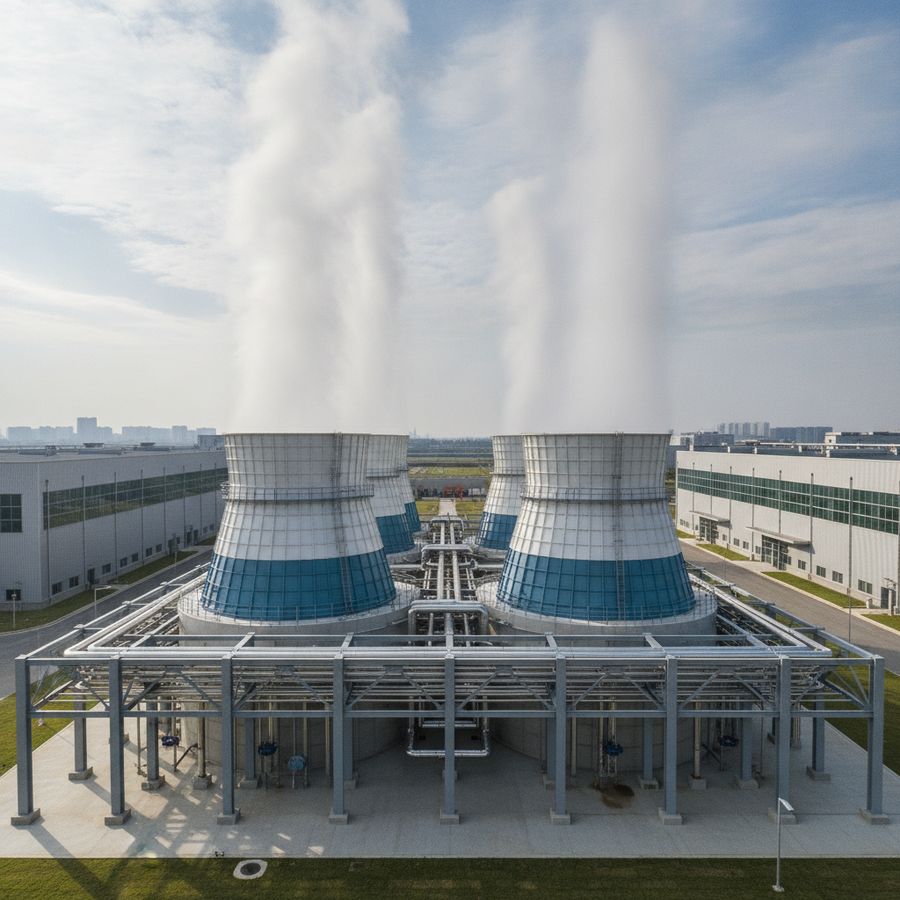
One of the most important principles in cooling tower placement is how air leaves the unit. In many industrial applications, evaporative cooling towers perform best when they use vertical air discharge, because the discharge pattern helps move warm, moisture-laden air upward and away from the tower. This reduces the risk of recirculation, a condition in which saturated discharge air is pulled back into the air inlet and lowers thermal efficiency.
Vertical discharge also improves operating consistency in exposed outdoor locations. When the tower throws air upward instead of sideways, its performance becomes far less sensitive to changing wind direction and wind intensity. This design advantage is especially valuable on crowded industrial sites where surrounding structures, process lines, or equipment can create turbulent air patterns. A tower that is less affected by wind is easier to position and more reliable over time.
Vertical air discharge supports stable heat rejection by reducing wind interference and limiting the chance of hot, humid air returning to the intake.
For designers and plant managers, this means more flexibility without sacrificing output. Instead of overcompensating for wind exposure, they can focus on maintaining proper clearance above and around the unit. In practice, vertical discharge is often the difference between a tower that merely fits the site and one that delivers dependable performance season after season.
When evaluating cooling tower placement, always consider whether the discharge pattern supports clean airflow separation. That single factor has a major impact on energy use, process temperature stability, and long-term service reliability.
What Site Conditions Affect Cooling Tower Output?
Even a well-designed tower can underperform if the site itself creates poor operating conditions. The output of evaporative cooling towers depends heavily on the quality of the surrounding airflow, the available clearance, and the ambient environment. Nearby walls, roofs, machinery, and enclosed yards can all restrict air intake or trap discharged heat and moisture around the tower.
Several site variables should be reviewed before finalizing cooling tower placement:
- Restricted airflow caused by buildings, fencing, or stacked equipment
- Hot air recirculation from discharge air returning to the intake
- High local heat loads from condensers, ovens, or process exhaust
- Dust, grease, or corrosive contaminants that affect fills and mechanical parts
- Uneven basin support or poor drainage around the installation area
Wind exposure matters, but it is only one part of the picture. A tower installed too close to a wall may struggle more than a tower in an open area with stronger winds. Elevation changes, overhead obstructions, and access limitations for maintenance also influence long-term efficiency. If technicians cannot easily inspect fans, motors, drift eliminators, or water distribution components, performance can slowly decline without obvious warning.
Reliable cooling tower output starts with a site that allows free air movement, easy maintenance access, and minimal recirculation risk.
For industrial refrigeration systems, placement should always be treated as a performance decision, not only a construction detail. Proper siting protects heat rejection capacity, simplifies upkeep, and helps the entire cooling loop operate more predictably.
How Do Indoor Installations Change Tower Design?
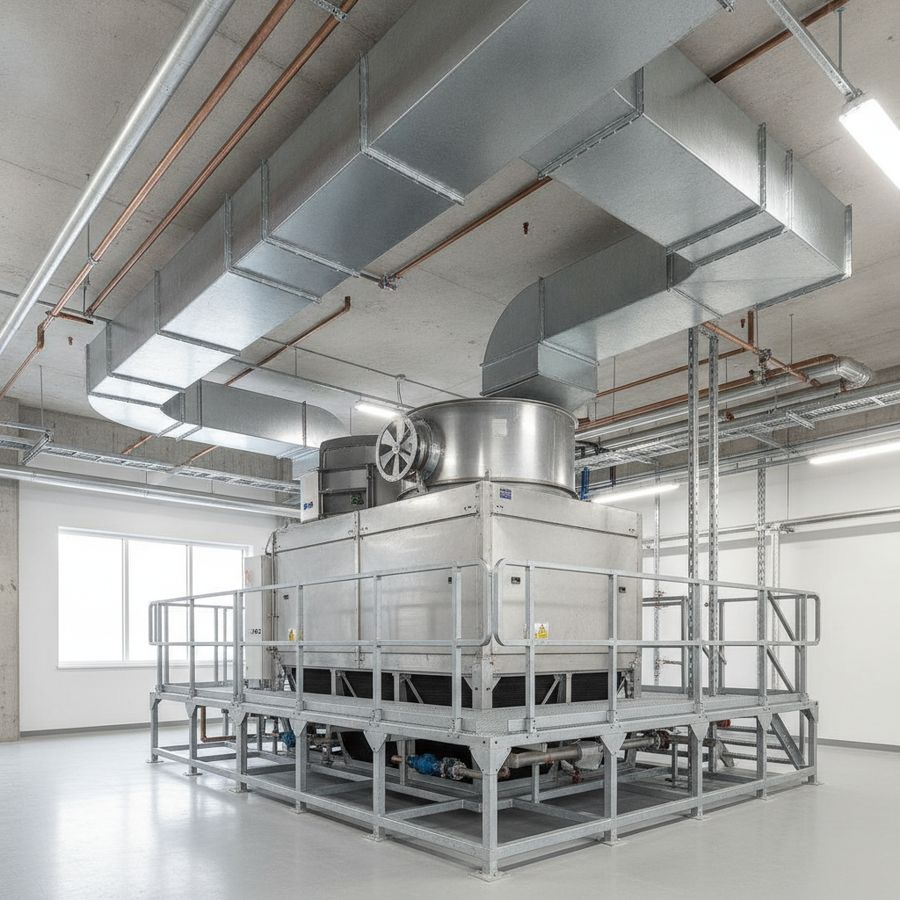
Indoor installations can solve space or weather exposure challenges, but they fundamentally change tower design requirements. A tower placed inside an industrial building cannot rely on open atmospheric airflow in the same way as a rooftop or yard-mounted unit. Instead, the system must be engineered to manage both supply air and exhaust air through controlled pathways, often with dedicated ducting.
This is where specialized configurations become essential. In enclosed premises, manufacturers may provide versions designed for indoor use with fan systems capable of overcoming higher static pressure. The goal is to move air effectively through ducts without sacrificing thermal performance. If airflow is undersized or poorly routed, the tower may draw back warm, humid exhaust air, reducing cooling efficiency and increasing the chance of condensation issues inside the building.
Indoor tower projects typically require attention to:
- Duct sizing for intake and discharge air
- Pressure losses across bends, louvers, and grilles
- Moisture management and vapor migration
- Service access for motors, fills, and basins
- Noise control within occupied production areas
When a cooling tower moves indoors, airflow control becomes a design system of its own rather than a simple placement choice.
Because of these factors, indoor applications often lead engineers toward centrifugal fan towers or other high-head solutions. The right configuration preserves process cooling while fitting the realities of a plant layout. In short, indoor placement is possible, but only when the tower is selected as part of a complete air-management strategy.
Centrifugal Fan Options for Ducted Airflow
When a project requires ducted air movement, centrifugal fan towers offer a practical solution. Unlike fan arrangements intended mainly for free discharge, centrifugal fans are better suited to applications with higher resistance in the air path. That makes them especially useful for indoor installations, rooftop mechanical rooms, or sites where air must be supplied to or recovered from a defined duct network.
The key advantage is pressure capability. Ducts, elbows, dampers, and discharge plenums all add static pressure that standard airflow arrangements may struggle to overcome. A properly selected centrifugal fan can maintain the required air volume across that resistance, helping the tower preserve heat rejection capacity. This directly supports stable process temperatures in demanding industrial refrigeration environments.
Beyond airflow strength, these tower options can improve layout flexibility. Engineers gain more freedom to position the unit where it best serves piping, structure, or maintenance circulation, rather than only where open air is available. That flexibility can be valuable in retrofit projects where the site has limited exterior space.
Centrifugal fan towers are chosen not simply for moving air, but for sustaining airflow when the system includes ducts and pressure losses.
To get the best results, designers should match fan selection to the full air path, not just the tower body. Underestimating resistance leads to poor performance, while correct sizing helps the installation operate as intended. In many constrained facilities, centrifugal fan towers make reliable tower placement possible where other configurations would be impractical.
Protective Materials That Extend Outdoor Service Life
Outdoor operation exposes cooling equipment to rain, UV radiation, temperature swings, airborne contaminants, and corrosive industrial atmospheres. That is why outdoor tower protection should be treated as a core design requirement rather than an optional upgrade. Material selection has a direct impact on service life, maintenance frequency, and long-term operating cost.
For durable evaporative cooling towers, heavy-gauge hot-dip galvanized sheet construction remains a proven solution. When paired with suitable protective coatings or paints, it creates a strong barrier against atmospheric agents and corrosion. This layered protection is especially important in sectors such as plastics, food processing, electroplating, and other industrial environments where humidity and airborne chemicals can accelerate wear.
Protection should also extend beyond the casing. Outdoor-ready towers benefit from watertight motors, sealed electrical components, and fan supports designed specifically for exterior exposure. These details help prevent water ingress, rust, and premature mechanical failure during year-round service.
- Hot-dip galvanized structural panels resist corrosion
- Protective paints add another defense layer
- Watertight motors improve electrical reliability outdoors
- Special fan support execution strengthens weather resistance
Outdoor tower protection is most effective when the entire assembly, not just the outer shell, is prepared for weather exposure.
For facility owners, the benefit is clear: better reliability, fewer shutdowns, and more predictable performance. In demanding climates, material quality often determines whether a tower delivers years of dependable cooling or becomes a recurring maintenance problem.
Control Dampers and Heaters for Seasonal Stability
Seasonal changes can place significant stress on tower operation, especially in climates with cold winters and variable shoulder-season temperatures. To maintain stable performance, many facilities add accessories that improve controllability and protect the system during low-ambient conditions. Two of the most useful options are capacity control dampers and winter defrosting heaters.
Control dampers, particularly on versions with centrifugal fans, help regulate airflow and match tower capacity to the actual thermal load. This is valuable when process demand fluctuates or when low outdoor temperatures would otherwise lead to overcooling. By controlling the air side of the system, operators can maintain more consistent water temperatures and reduce unnecessary fan energy.
Heaters play a different but equally important role. During freezing conditions, basin water and exposed components can be vulnerable to ice formation when circulation is reduced or the system cycles at light load. Electric heaters help protect the tower during shutdowns and winter operation, supporting safer starts and reducing cold-weather damage.
Seasonal stability depends on more than tower size alone; it also requires accessories that let the unit adapt to changing ambient conditions.
For industrial users, these features improve reliability across the full operating year. A tower equipped with dampers, heaters, and appropriate controls is easier to manage, better protected in winter, and more responsive to real process needs. In advanced cooling tower placement planning, these accessories are part of the performance strategy, not afterthoughts.
