


Process Tolerance Bands Define Thermoregulation Architecture Choices
Every thermoregulation system starts with one practical question: how tightly must the process temperature be held to protect quality, cycle time, and throughput? Tolerance bands determine whether a production line can operate efficiently with a simpler cooling loop or whether it requires a more advanced architecture with faster response, finer modulation, and layered safeguards. In other words, the narrower the acceptable range, the more deliberate the system design must be.
For stable plastics processing, food handling, electroplating, and other thermal-sensitive applications, even minor variation can affect viscosity, surface finish, dimensional accuracy, or material behavior. A line that tolerates a wider band may perform well with straightforward cooling capacity and basic controls. A line with very tight limits often benefits from integrated chillers, central heating units, cooling towers, and responsive control logic working together.
Stable production depends less on chasing a single setpoint and more on maintaining the right operating band under changing loads
Companies focused on stable production should size and configure equipment around real process tolerance instead of nominal temperature targets alone. That is where architecture choices become strategic rather than purely mechanical. Tailor-made industrial refrigeration and temperature control solutions are especially valuable when ambient conditions, line speed, or product changeovers regularly shift the thermal load.
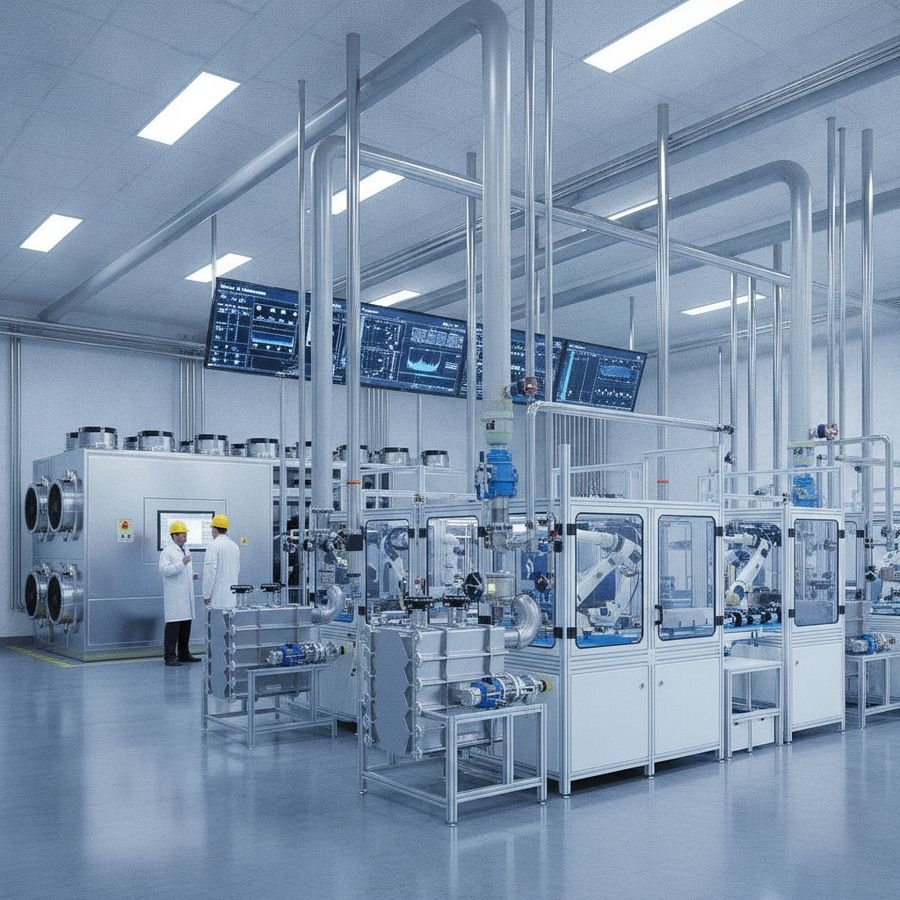
What Factors Matter Most in System Design?
The most effective system design for industrial temperature control balances process needs, plant conditions, and operator realities. Cooling capacity matters, but it is only one part of performance. Designers must also evaluate heat load variability, ambient temperatures, production speed, fluid type, pressure losses, control accuracy, maintenance access, and future expansion.
For example, a line exposed to seasonal conditions may need equipment that maintains output despite weather changes. Frimec’s experience in industrial refrigeration highlights why component durability, outdoor suitability, and configuration flexibility matter in real facilities. Features such as protected construction, watertight motors, integrated pumps, and control panels support reliability where equipment must run continuously and safely.
-
Process load profile: constant or highly variable thermal demand
-
Required accuracy: broad cooling need versus precise thermal stability
-
Installation environment: indoor, outdoor, dusty, humid, or exposed areas
-
Utilities and footprint: water availability, airflow, and space constraints
-
Serviceability: access for maintenance without disrupting production
Operator training should also be considered from the beginning. A technically impressive system can still underperform if daily use is confusing. The best thermoregulation layouts are not only efficient but intuitive, robust, and built around the plant’s actual production habits.
How Much Temperature Drift Can Production Accept?
Acceptable temperature drift is never just a technical detail; it is a direct business decision. If production can absorb small variations without affecting quality, scrap, or cycle time, the thermoregulation system can be optimized for efficiency and durability rather than extreme precision. If the process reacts quickly to minor changes, tighter controls become essential for stable production.
Manufacturers should measure how drift influences the end result. In some lines, a deviation of one or two degrees may be harmless. In others, it can lead to inconsistent dimensions, poor coating adhesion, slower cooling, or material stress. Looking only at machine specifications is not enough; the true benchmark is how finished product quality changes under real operating conditions.
Temperature drift should be defined by process consequences, not by guesswork or habit
A practical review often includes trend data, reject rates, and shift-by-shift performance. This makes it easier to determine whether tighter temperature control will improve margin or simply increase system complexity. Once the acceptable drift is clear, engineers can choose the right sensors, control strategy, and hydraulic layout. That clarity prevents overdesign on forgiving lines and underdesign on critical ones, both of which can quietly reduce efficiency over time.
Hydraulic Layout Influences Response Time and Control Accuracy
The hydraulic layout of a cooling or heating circuit strongly affects how quickly the process responds and how precisely temperatures can be maintained. Even high-quality components cannot deliver optimal performance if the piping arrangement creates unnecessary delay, poor circulation, or unstable flow. In a well-planned thermoregulation system, the hydraulic path is treated as part of the control strategy, not just the plumbing.
Pipe length, diameter, pump selection, buffer volume, valve placement, and the separation of primary and secondary circuits all influence response time. A system with excessive fluid volume may be stable but slow to correct deviations. A system with insufficient buffering may react quickly yet overshoot. The goal is to match the thermal inertia of the circuit to the process itself.
-
Shorter, efficient circuits usually improve response speed
-
Balanced flow rates help maintain control accuracy across all users
-
Correct pump sizing reduces wasted energy and erratic performance
-
Thoughtful circuit zoning supports different loads on the same line
For industrial refrigeration applications, architecture should also consider installation flexibility and service conditions. When hydraulic layout is optimized early in system design, plants typically see more consistent operating temperatures, fewer control corrections, and better long-term efficiency.
Training Requirements Shape Safer Day-to-day Operation
Even the best-engineered temperature control equipment depends on capable daily use. That is why operator training should be treated as a core design requirement rather than a final handoff step. Operators need to understand setpoints, alarm priorities, startup and shutdown routines, and the consequences of manual overrides. Without that clarity, avoidable errors can compromise quality and safety.
Training should be matched to the complexity of the plant. A simple line may only require routine checks and escalation steps. A more advanced thermoregulation system with multiple circuits, heating and cooling stages, or seasonal operating modes needs deeper procedural guidance. Maintenance staff also need targeted instruction so they can troubleshoot issues without creating new instability.
Safer operation is built when people know not only what to do, but why the system reacts the way it does
Effective training usually covers normal operation, common fault scenarios, hygiene or contamination risks where relevant, and energy-conscious use. Visual controls and standardized procedures help reinforce good habits. For businesses prioritizing stable production, training reduces downtime, shortens recovery after alarms, and builds confidence across shifts. In the long term, a well-trained team protects both equipment life and product consistency.
Which Industries Need the Tightest Temperature Control?
Many sectors benefit from reliable thermal stability, but some require exceptionally tight temperature control because their materials or processes react immediately to change. In these environments, the thermoregulation system is directly tied to quality, compliance, and productivity. Tight control helps keep output uniform even when line speed, ambient conditions, or batch characteristics shift.
Plastics processing is a prime example, as mold cooling and material behavior can change quickly with small thermal deviations. Electroplating also demands consistency because bath conditions influence coating quality and repeatability. Food applications often need careful thermal management to support product integrity and process hygiene. Other precision manufacturing settings, including specialized chemical or engineered material production, may require similar accuracy.
-
Plastics: cycle stability, dimensional accuracy, and finish quality
-
Electroplating: bath consistency and coating reliability
-
Food processing: controlled temperatures for product protection and repeatability
-
Specialty industrial applications: thermal stability for process-sensitive materials
These industries often gain the most from tailor-made industrial refrigeration solutions because generic layouts may not respond fast enough or hold the right tolerance band. When temperature sensitivity is high, system precision becomes a competitive advantage, not just an engineering preference.
Control Panels and Alarms Reduce Operator Error
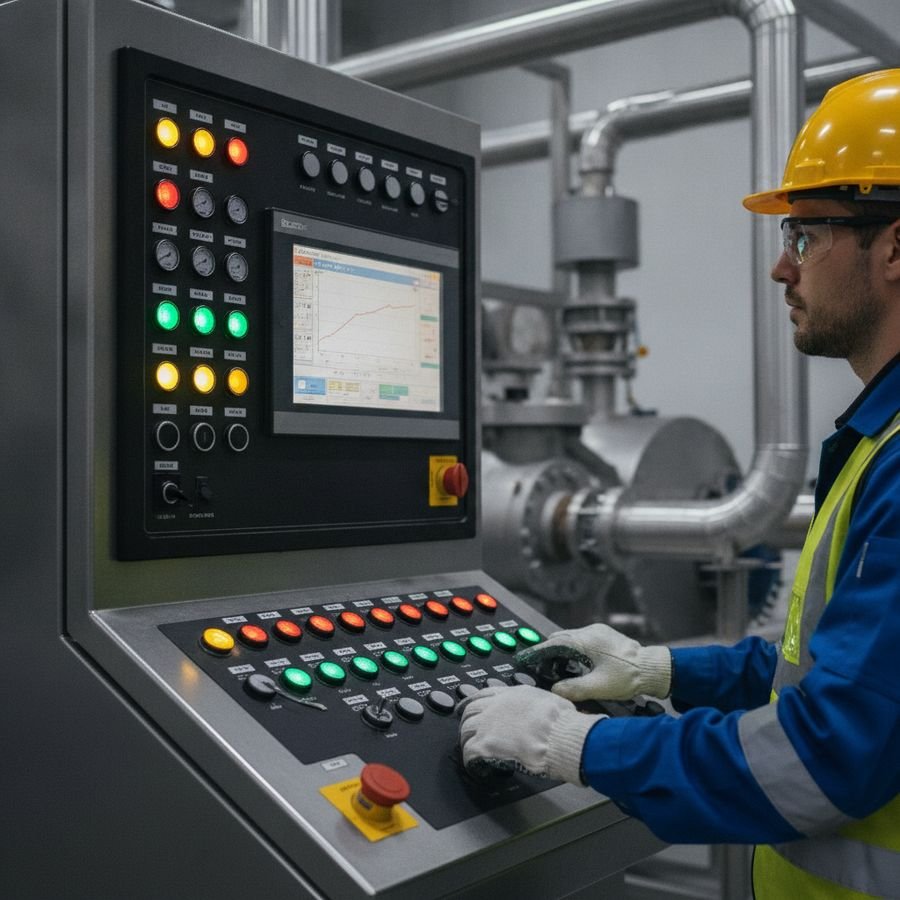
Clear control panels and well-structured alarms play a major role in keeping industrial temperature control dependable. In fast-moving production environments, operators cannot waste time guessing whether a warning is critical, what parameter moved out of range, or which response comes first. Good interface design turns complex thermal processes into manageable, repeatable actions.
Integrated panels are especially valuable when they present key data in a logical order: process temperature, setpoint, status, pump activity, and alarm history. This helps teams detect drift early instead of reacting only after product quality suffers. Alarm design matters just as much. Too few alarms leave operators blind; too many create fatigue and ignored warnings.
-
Prioritized alarms improve response during faults
-
Simple navigation reduces mistakes during adjustments
-
Trend visibility helps identify recurring instability
-
Standardized messages support faster training across shifts
For a stable production line, the objective extends beyond mere notification to include guided action. Panels and alarms should align with how people actually work, accommodating shift changes and maintenance routines. When integrated with robust operator training, these elements help minimize avoidable downtime, reduce manual errors, and enhance confidence in the overall system design. To learn more about optimizing your production line, visit Frimec.
FAQs
Why do temperature tolerance bands matter in thermoregulation system design?
Tolerance bands define how tightly a process temperature must be held to protect quality, throughput, and cycle time. Wider bands may allow a simpler cooling loop, while narrow bands usually require faster controls, better hydraulic design, and more safeguards.
How do manufacturers decide how much temperature drift is acceptable?
They should measure how drift affects real production outcomes such as reject rates, surface finish, dimensions, adhesion, cycle time, and material behavior. Acceptable drift should be based on process consequences, not guesswork or nominal machine specifications.
How does hydraulic layout affect temperature control performance?
Hydraulic layout influences response time, circulation stability, and control accuracy. Pipe length, diameter, pump sizing, buffer volume, valve placement, and circuit separation all affect whether the system reacts smoothly or overshoots under changing loads.
Why is operator training important for stable production?
Even a well-engineered system can underperform if operators do not understand setpoints, alarms, startup routines, shutdown steps, and manual overrides. Good training reduces avoidable errors, shortens alarm recovery time, and supports safer daily operation.
Which industries usually need the tightest temperature control?
Plastics processing, electroplating, food processing, and other process-sensitive manufacturing environments often need tight thermal stability. Small temperature changes in these sectors can quickly affect coating quality, dimensional accuracy, hygiene, finish quality, or material performance.
