


Where Air-cooled Systems Simplify Plant Design
For many factories, air cooled chillers are the fastest route to a dependable cooling package because they remove heat directly to ambient air without the extra loop of a condenser-water system. That means no cooling tower basin, no tower pump set, no water-treatment skid, and fewer field connections during installation. In an air cooled vs water cooled comparison, this simpler layout often reduces engineering hours as much as equipment count.
That simplicity matters when a plant is expanding in phases, retrofitting an older building, or placing equipment on a roof or yard with limited utility infrastructure. Electrical coordination is usually more straightforward, and startup can move faster because there are fewer interacting components to balance. For users that value predictable commissioning, this can lower project risk even if nameplate efficiency is not the absolute best.
When process uptime and installation speed matter more than squeezing every last kWh from peak summer operation, air-cooled equipment often delivers the better total project outcome.
For industrial refrigeration specialists such as Frimec, the appeal is clear: a compact, tailor-made package can support plastics, electroplating, food, and other process loads while keeping the surrounding plant design lean and easier to manage over time.
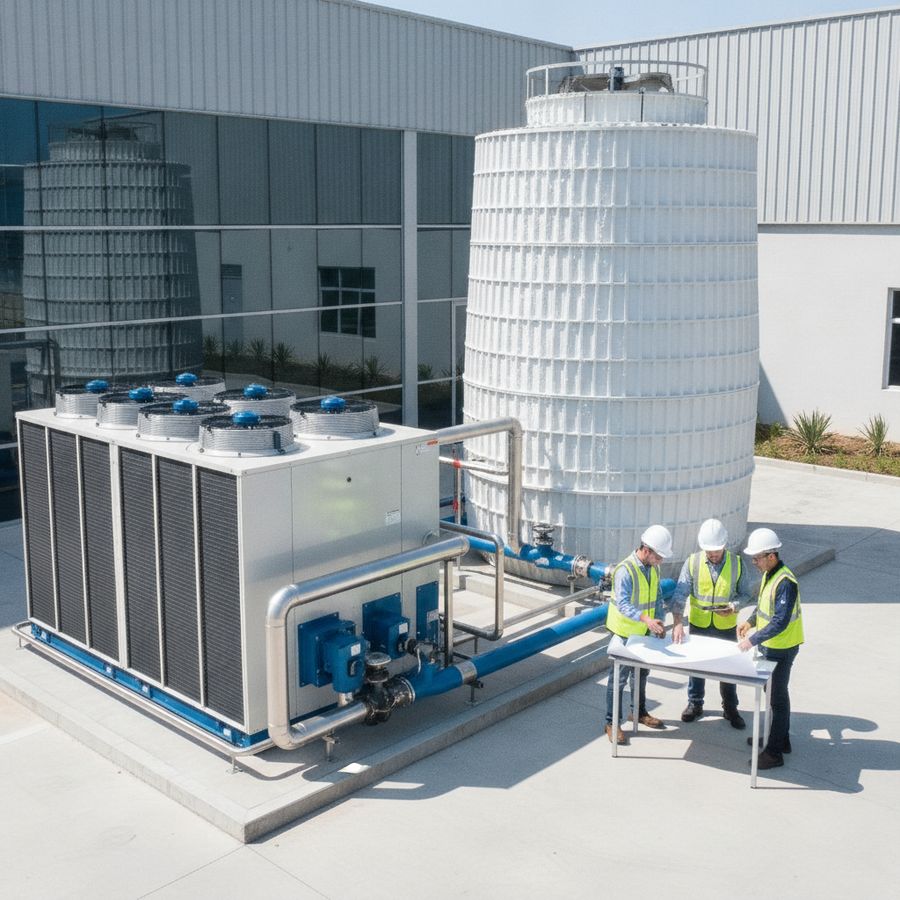
When Cooling Towers Win on Operating Efficiency
Cooling towers usually win when the main target is low long-term operating cost, especially on large process loads that run many hours per year. Because an evaporative tower rejects heat near the wet-bulb temperature instead of the dry-bulb temperature, the condensing side of the system can often operate at a lower temperature than comparable air cooled chillers. Lower condensing temperature translates into reduced compressor lift and better system efficiency.
This advantage becomes more meaningful as tonnage increases. A plant with steady 24/7 production can recover the added complexity of pumps, tower fans, and water treatment through energy savings over the equipment life. In facilities where electricity is expensive, that delta can be substantial.
Still, efficiency should be evaluated at the system level, not by tower performance alone. A well-selected tower package may include features such as vertical air discharge, weather-resistant construction, and optional capacity control dampers to match process load more precisely. Those design details matter because stable heat rejection improves the overall behavior of industrial cooling systems.
-
Best fit for high annual run hours
-
Often stronger at larger capacities
-
Can reduce compressor energy in hot weather
Comparing Water Use, Space, and Maintenance
The practical difference between cooling towers and air cooled chillers often shows up in three areas: water, footprint, and maintenance. Air-cooled systems use very little process-side makeup beyond the closed loop, which makes them attractive in regions where water is scarce, expensive, or tightly regulated. Towers, by contrast, consume water through evaporation, drift, and blowdown, so utility cost and water-management policy must be part of the financial model.
Space is less obvious. An air-cooled chiller may need a clear outdoor area with strong airflow and service access around the condenser coils. A tower-based system breaks equipment into more pieces, but can sometimes place them more flexibly. For example, evaporative towers with vertical air discharge can be positioned to reduce sensitivity to wind direction, and some versions can even support ducted indoor applications with centrifugal fans.
Maintenance is the tradeoff most procurement teams underestimate. Air-cooled machines generally emphasize coil cleaning, fan service, and refrigerant-side care. Tower systems add basin cleaning, water treatment, scale control, corrosion monitoring, and seasonal protection.
The lower-maintenance option is not always the lower-cost option, but it is often the easier option for teams with limited in-house utility staff.
Climate Conditions That Change Total Ownership Cost
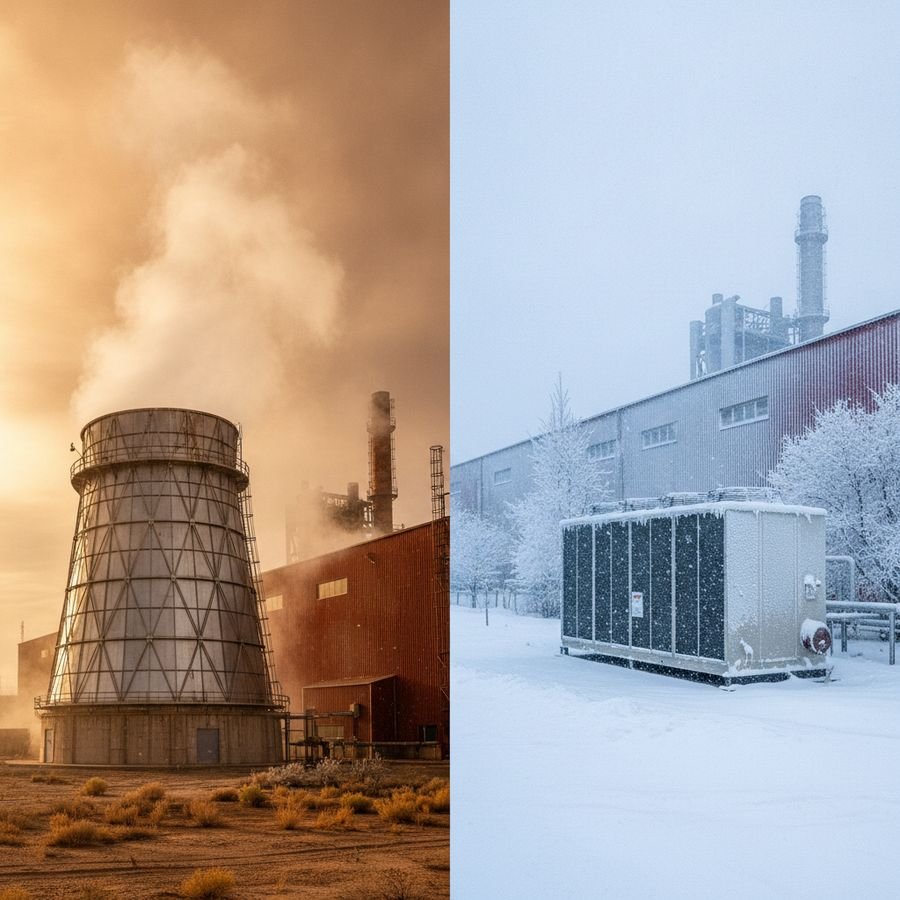
Climate can completely change the answer in an air cooled vs water cooled evaluation. In hot, dry regions, evaporative heat rejection can be highly effective because the wet-bulb temperature stays meaningfully below the dry-bulb temperature. That gives cooling towers a strong seasonal efficiency edge and can lower annual operating cost enough to outweigh the burden of water treatment and added auxiliaries.
In humid climates, that gap may narrow. Towers still perform well, but the evaporative advantage is less dramatic, so the payback period can stretch. Meanwhile, in colder regions, air cooled chillers may benefit from winter and shoulder-season operation, and some plants can exploit low ambient conditions to reduce mechanical cooling demand.
Freeze risk also matters. Towers may require basin heaters, defrost strategies, drain-down planning, or other winter provisions to stay reliable. Outdoor materials and motor protection become part of lifecycle planning, especially in exposed industrial sites. Durable construction such as hot-dip galvanized panels and weather-protected components can improve resilience where rain, wind, and contaminants are constant concerns.
The right decision is rarely universal. It depends on local weather profiles, energy tariffs, water pricing, and how many hours the process actually runs near design load.
Application Examples From Plastics and Electroplating
In plastics processing, cooling demand is often repetitive, quality-sensitive, and tied directly to cycle time. Molds, hydraulic circuits, and process loops need stable temperatures to maintain dimensional consistency and throughput. Here, air cooled chillers are frequently chosen for their simplicity, especially in plants that want a self-contained utility package for presses or extrusion lines. They reduce supporting infrastructure and can be easier to replicate as production cells expand.
Electroplating presents a different picture. Bath temperatures, rectifier heat, and continuous process schedules can favor cooling towers or water-cooled arrangements when the load is large and persistent. In these environments, heat rejection efficiency can directly influence energy spend across the year. Robust materials, outdoor-ready motors, and accessories for airflow control are particularly valuable when equipment must withstand aggressive industrial surroundings.
Both sectors also illustrate why industrial cooling systems should be matched to the production profile rather than selected by habit.
-
Plastics: modular growth, fast installation, stable process temperatures
-
Electroplating: long operating hours, high thermal loads, efficiency-driven utility planning
-
Shared need: reliable uptime and temperature control tailored to the process
A supplier with experience across plastics, electroplating, food, and related industries can usually identify these use-case differences early and avoid expensive oversimplification.
Questions Engineers Should Settle Before Procurement
Before requesting quotations, engineers should define the decision criteria in terms the finance team and production team can both use. Too often, equipment is compared only on purchase price, even though the real question is lifecycle value. The shortlist should include peak load, minimum load, annual run hours, target leaving-water temperature, ambient design conditions, and the acceptable range of downtime during service.
It is also crucial to clarify what the plant can realistically support. Does the site have reliable water quality management? Is there staff available to maintain a tower, pumps, and basin hygiene program? Is water cost increasing faster than power cost? Will the equipment be exposed to freezing weather outdoors, or will it require ducted air indoors? These factors will determine whether cooling towers or air-cooled chillers yield the best long-term operating cost.Procurement works best when the team agrees on total ownership cost inputs before comparing equipment proposals.
-
What are the true utility rates for water and electricity?
-
How many hours per year will the process run?
-
What maintenance resources are available on site?
-
How much space and airflow clearance is actually usable?
Once those questions are settled, an air cooled vs water cooled decision becomes more objective, and the chosen system is far more likely to perform as expected in real production.
