


Process Temperature Demands Differ by Production Line
Choosing cooling systems starts with a simple truth: not every production line removes heat in the same way. In plastics cooling, injection molding, extrusion, and blow molding all create different thermal profiles, cycle times, and sensitivity to temperature drift. Food processing is equally varied, with washing, mixing, cooking support, packaging, and ingredient handling each placing their own demands on coolant temperature and stability.
That is why engineers should look beyond a generic capacity figure. A line that needs rapid mold cooling may require tighter temperature control than a line that mainly rejects background equipment heat. Likewise, a food plant may prioritize stable cooling water temperatures to protect product consistency, while also meeting sanitation expectations. The correct solution depends on process conditions, production rhythm, and product quality targets.
Reliable temperature control is not just about reaching a setpoint, but about holding it consistently under changing plant loads
When comparing options such as air chillers and cooling towers, decision-makers should map the real operating profile first. Key questions include:
-
What inlet and outlet temperatures are required?
-
How fast does the load change during production?
-
Is the process sensitive to even small thermal fluctuations?
-
Are uptime and seasonal performance equally important?
A tailored review of these factors leads to a more efficient and dependable system choice.
Which Cooling Loads Are Typical in Plastics?
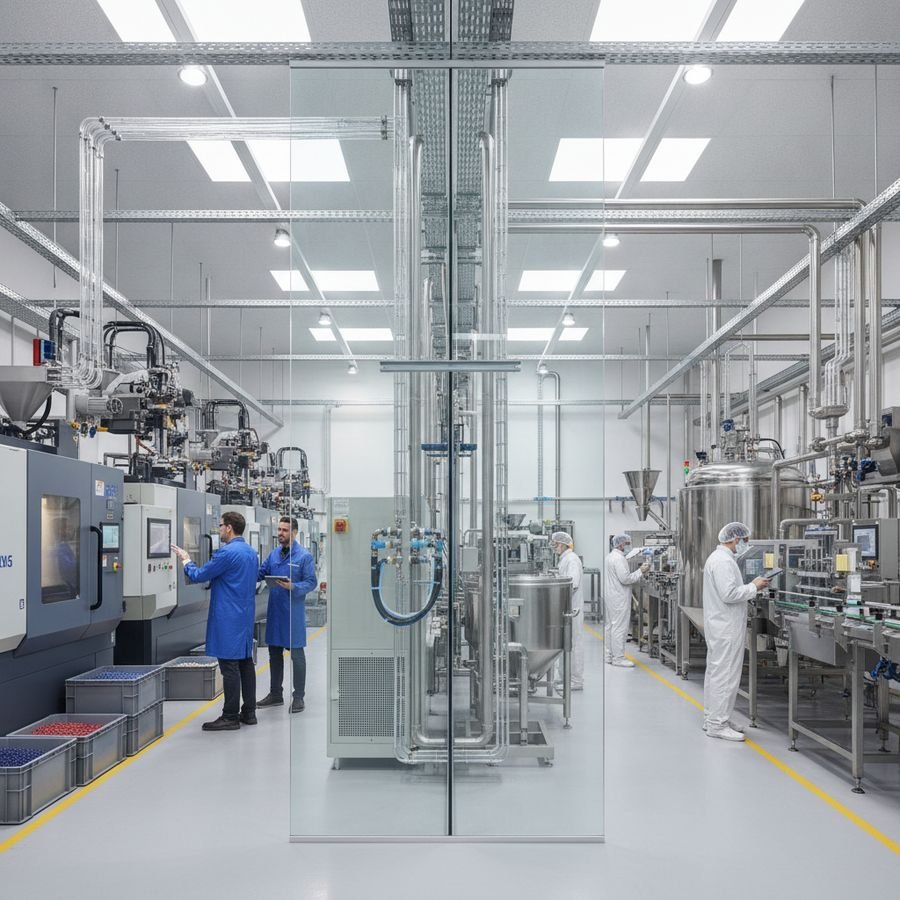
In plastics manufacturing, cooling demand often comes from several sources at once. Molds, hydraulic circuits, gearboxes, oil systems, and downstream handling equipment can all contribute to the total heat load. For this reason, plastics cooling is rarely a one-device calculation. A line may appear modest on paper, yet experience major performance issues if thermal loads spike during peak production or tool changes.
Injection molding typically needs fast, repeatable heat removal to shorten cycle times and maintain dimensional accuracy. Extrusion lines often require steady cooling over longer runs, where variations can affect surface finish, wall thickness, or output stability. Auxiliary equipment may also add hidden demand, especially in facilities running multiple presses or mixed processes at the same time.
Typical load planning should include both process and ambient influences. Warm factory conditions, future machine additions, and part design changes can all increase demand. Underestimating load is one of the most common causes of unstable production quality.
In plastics plants, cooling capacity must support both today’s throughput and tomorrow’s expansion
Well-matched systems help control shrinkage, cycle time, and repeatability. Whether using centralized cooling or machine-specific units, the goal is the same: dependable heat removal that supports consistent production output without overcomplicating maintenance.
How Do Food Plants Prioritize Hygiene Requirements?
In food processing, cooling performance is only one part of the specification. Hygiene, cleanability, and contamination risk are often just as important as temperature control. Plants must consider how a cooling system interacts with production zones, washdown routines, water quality management, and overall plant safety. Equipment selection therefore tends to be more conservative and more application-specific than in many other industries.
Open and closed cooling arrangements each have advantages, but food facilities often prefer designs that reduce exposure, simplify monitoring, and support sanitary operating practices. Materials of construction, drainage, accessibility for inspection, and resistance to harsh cleaning environments all matter. If cooling equipment is installed near sensitive areas, plant teams may also prioritize low drift, controlled airflow, and easy service access.
The right design balances process efficiency with practical hygiene control. This is especially important where cooled water supports packaging equipment, thermal processes, or product-adjacent machinery.
-
Favor layouts that separate utility equipment from hygienic zones where possible
-
Plan for easy inspection and preventive maintenance
-
Account for water treatment and seasonal operating changes
-
Choose components suited for demanding industrial environments
For food plants, the best cooling strategy is one that protects product quality while making compliance and daily operation easier for the maintenance team.
Air Chillers Suit Many Fast-cycle Applications
Air chillers are often a strong fit for applications that need responsive, controlled cooling without relying on an external water source for heat rejection. In both plastics and food environments, they can support lines where compact installation, straightforward operation, and close temperature management are priorities. Their appeal is especially clear in fast-cycle applications, where process temperatures must recover quickly between production steps.
In plastics cooling, air chillers are frequently selected for individual machines or process cells that benefit from dedicated control. This can help stabilize mold temperatures, improve repeatability, and reduce the risk of one line affecting another. In food processing, they may support packaging or utility loads where a closed-loop approach is preferred.
Because they reject heat directly to ambient air, performance should be evaluated against real seasonal conditions. High outdoor temperatures can reduce efficiency, so proper sizing and airflow planning are essential. When matched correctly, air chillers deliver flexible and clean operation with reduced infrastructure complexity.
Air chillers work best when the application values control, simplicity, and fast thermal response
They are often ideal when a plant needs modular expansion, machine-level independence, or a cooling solution that can be deployed with minimal supporting infrastructure.
Cooling Towers Support Larger Heat Rejection Needs
When plants need to reject substantial amounts of heat efficiently, cooling towers become an important option. They are widely used across plastics cooling and food processing because they can support larger centralized systems and demanding industrial duty. For operations with multiple lines or high continuous loads, towers can offer a practical path to stable thermal performance and lower operating costs compared with less suitable alternatives.
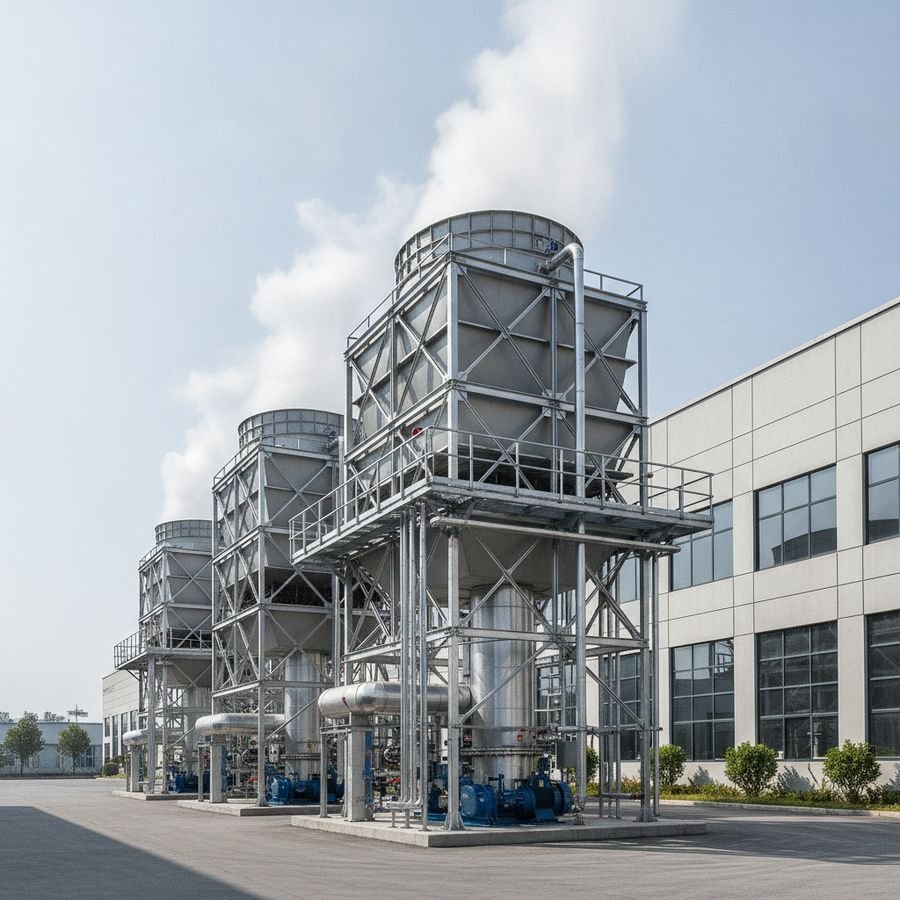
FRIMEC’s industrial approach highlights why tower design matters. Its TRA series evaporative cooling towers are built for flexibility in positioning, with vertical air discharge that helps operation remain independent from wind direction and intensity. For indoor industrial installation, versions with high head centrifugal fans allow ducting of supply or recovered air. The towers are also described as being constructed in high-thickness hot-dip galvanized sheet with protective paint systems for resistance to atmospheric exposure.
Optional features such as capacity control dampers, circulation pumps, electrical command panels, and winter defrosting heaters can further adapt the system to site conditions. This reflects the core advantage of choosing cooling systems around actual plant needs rather than standard assumptions.
For large heat rejection duties, a well-engineered tower system can improve energy performance, support uptime, and give expanding factories the scalability they need.
What Sizing Errors Create Unstable Temperatures?
Many temperature problems do not come from poor equipment quality, but from poor sizing logic. A system can be oversized, undersized, or simply mismatched to the process profile. In all three cases, the result may be unstable temperatures, wasted energy, and unnecessary wear on compressors, pumps, or fans. This is why choosing cooling systems should always involve a realistic review of load diversity, peak demand, and operating conditions.
Undersizing is the most obvious issue. If capacity cannot absorb peak heat loads, the process drifts above target temperatures, cycle times lengthen, and product quality may suffer. Oversizing creates a different set of problems, including short cycling, poor control accuracy, and inefficient operation at part load. Distribution mistakes can be equally damaging, especially when pipework, flow rates, or buffer volume are not matched to the application.
-
Ignoring seasonal ambient changes
-
Using nameplate loads instead of real process loads
-
Forgetting future expansion or simultaneous machine operation
-
Overlooking pressure drop and circulation performance
Stable cooling depends on correct capacity, correct flow, and correct control strategy working together
Careful sizing protects process consistency in both plastics cooling and food processing, while also reducing downtime caused by alarms, thermal instability, and repeated manual adjustments.
Tailored System Layouts Improve Uptime and Quality
The most effective cooling strategies rarely stem from choosing a single product in isolation. Instead, they emerge from crafting a comprehensive layout that aligns with production goals, site constraints, maintenance resources, and future growth. This is where tailored engineering truly adds value. Depending on how the factory operates, a centralized plant, distributed air chillers, a tower-assisted loop, or a hybrid arrangement may each be the right choice.
FRIMEC specializes in industrial refrigeration and temperature control with customized solutions for large industrial production facilities, making this approach particularly relevant. In a plastics plant, a bespoke layout can effectively segregate critical molds from less sensitive utilities, enhancing consistency where it is most needed. In the food processing industry, it can facilitate cleaner zoning, easier maintenance access, and improved uptime across packaged or ingredient-handling operations.
System layout impacts quality just as significantly as equipment selection does. The optimal design incorporates redundancy, water routing, control logic, service accessibility, and operational flexibility right from the start.
Tailored cooling layouts transform temperature control from a utility expense into a production advantage. When cooling towers, air chillers, and supporting controls are organized around the plant’s realities, businesses achieve more reliable production, steadier product quality, and a solid foundation for long-term efficiency.
FAQs
How do you choose cooling systems for plastics and food processing?
Start with the real process profile rather than nominal capacity alone. Compare required inlet and outlet temperatures, load swings, sensitivity to temperature drift, hygiene needs, ambient conditions, and future expansion before selecting equipment.
When are air chillers a better choice than cooling towers?
Air chillers are often better for fast-cycle applications, machine-specific cooling, modular expansion, and sites that prefer closed-loop operation without depending on a separate water source for heat rejection. They are especially useful when temperature control and simple infrastructure are priorities.
When do cooling towers make more sense?
Cooling towers are usually a stronger fit for larger centralized systems and facilities with high continuous heat rejection loads. They can improve scalability and operating efficiency when multiple production lines or major industrial processes must be supported.
What sizing mistakes cause unstable process temperatures?
Common mistakes include undersizing for peak loads, oversizing that causes short cycling, using nameplate values instead of real operating loads, ignoring seasonal ambient conditions, and failing to account for pressure drop, flow rate, and future machine additions.
Why do hygiene requirements change cooling system design in food plants?
Food plants must consider cleanability, contamination risk, washdown exposure, drainage, inspection access, airflow control, and water quality management alongside cooling performance. These factors often favor application-specific layouts that support sanitation and easier maintenance.
