


Why Plastics Plants Need Stable Process Cooling
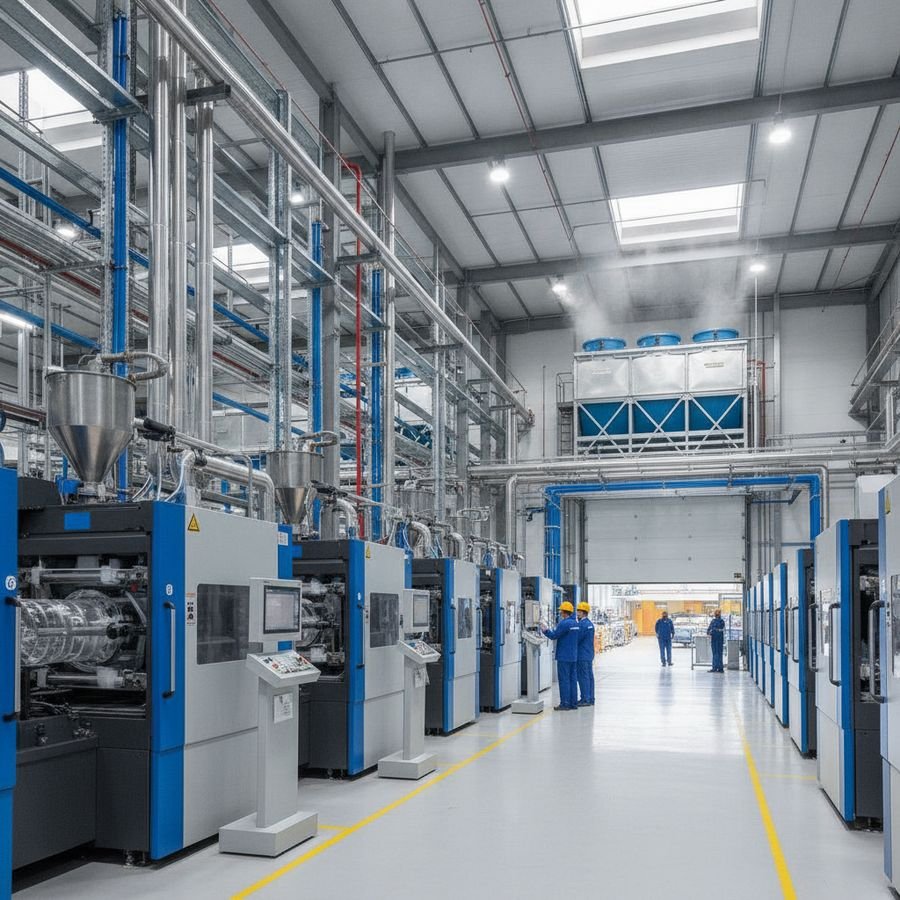
In the plastics industry cooling chain, temperature stability is not a convenience; it is a production requirement. Injection molding, extrusion, blow molding, and thermoforming all depend on repeatable heat removal from molds, hydraulic circuits, and process fluids. When process cooling fluctuates, cycle times drift, dimensions move out of tolerance, and surface quality can decline. Even a small variation in cooling water temperature can affect part shrinkage, warpage, gloss, and mechanical performance.
Reliable cooling towers help plastics plants protect throughput while lowering stress on upstream industrial refrigeration equipment. By rejecting heat efficiently, an evaporative cooling tower can support chillers and thermoregulation systems, reduce peak operating strain, and maintain the steady thermal conditions that production managers need for predictable output. That matters especially in facilities running multiple machines with different duty cycles across long shifts.
Stable cooling supports stable quality, shorter cycle times, and better overall equipment efficiency.
From a buying perspective, plants should evaluate more than nominal cooling capacity. The right system must match process load profiles, seasonal climate conditions, water management practices, and installation constraints. For high-volume plastics production, the best result comes from a cooling solution designed for continuous industrial service rather than light commercial duty.
-
Consistent mold temperature improves part repeatability
-
Controlled heat rejection helps reduce scrap and rework
-
Stable thermal performance supports energy-efficient operations
-
Well-matched equipment protects uptime during demanding production runs
Open Loop Versus Closed Loop Cooling Towers
One of the first buying decisions is whether an open loop or closed loop arrangement best fits the plant. In an open loop system, process water is cooled through direct exposure to the tower environment, making it a common and cost-effective option where water treatment programs are well managed. For many plastics applications, open loop cooling towers offer strong heat rejection performance and a practical balance between capital cost and thermal efficiency.
Closed loop systems, by contrast, keep the process fluid contained within a sealed circuit while tower water cools it indirectly through a heat exchanger or coil. This design is often preferred when the process demands cleaner fluid, tighter contamination control, or protection for sensitive equipment. In some industrial refrigeration layouts, a closed approach can also simplify maintenance on downstream machinery by reducing fouling risk.
The choice depends on plant priorities. If maximum heat rejection and straightforward service are the main goals, an evaporative cooling tower in open loop configuration may be the better fit. If product quality, fluid cleanliness, or equipment protection carries greater weight, a closed loop design may justify the extra investment.
The best tower selection is not universal; it should follow the fluid quality, maintenance strategy, and production risk profile of the facility.
Buyers should also account for local water conditions, treatment resources, and how the system will integrate with mold cooling, central thermoregulation, and seasonal operating demands.
Vertical Air Discharge in Tight Plant Layouts
Space is often limited in plastics manufacturing sites, especially where cooling equipment must be added to existing facilities. That is why vertical air discharge can be a major buying priority. According to FRIMEC’s TRA series design approach, vertical discharge allows maximum flexibility in positioning and makes tower operation largely independent of wind direction and intensity. For plants dealing with crowded yards, adjacent structures, or constrained service corridors, this feature can simplify layout planning and help preserve reliable thermal performance.
From an engineering standpoint, vertical discharge helps move warm, moist air upward rather than across neighboring equipment or walkways. This can reduce recirculation risks in difficult installations and improve airflow behavior when a tower is placed close to walls or other obstructions. In practical terms, a well-positioned evaporative cooling tower can deliver better process cooling consistency without requiring an oversized footprint.
This matters in expansion projects where production capacity has grown faster than utility space. Instead of compromising machine placement or access for maintenance, plants can prioritize tower configurations that fit tighter envelopes while still meeting heat rejection targets.
-
Useful for retrofit projects with limited outdoor area
-
Helps reduce sensitivity to changing wind conditions
-
Supports cleaner airflow management around the installation
-
Can improve serviceability by reducing awkward placement compromises
When floorplan flexibility is limited, airflow direction becomes a strategic specification rather than a minor detail.
How Galvanized Steel Improves Outdoor Durability
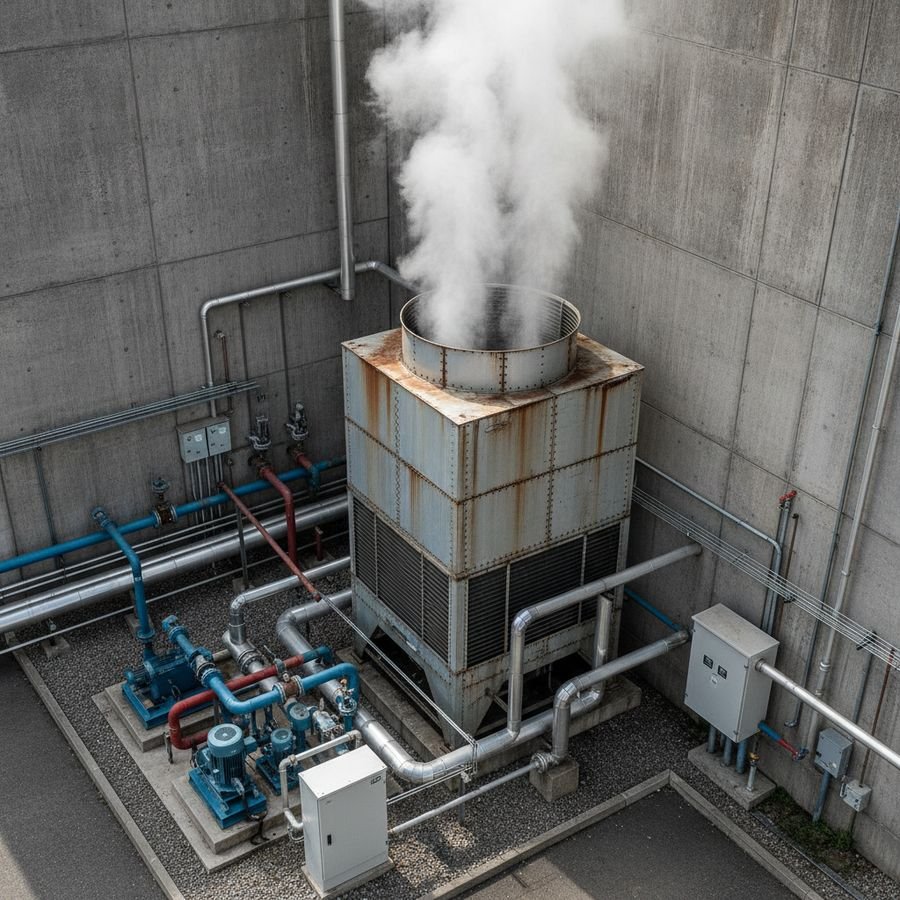
Outdoor cooling equipment in industrial environments must stand up to weather, moisture, airborne contaminants, and long operating hours. For that reason, material construction deserves close attention during the buying process. FRIMEC highlights that its TRA cooling towers are built in high-thickness hot-dip galvanized sheet and further protected by suitable paints, a combination aimed at improving resistance to atmospheric agents. For plastics plants, this is not just about appearance; it is about long-term structural reliability.
A tower exposed to rain, sun, temperature swings, and chemically aggressive surroundings can deteriorate quickly if protective materials are inadequate. Galvanized steel provides a durable barrier against corrosion, helping preserve panel integrity, support structure strength, and overall service life. Over time, stronger outdoor protection can reduce maintenance frequency, limit premature replacement, and support a lower total cost of ownership for industrial refrigeration infrastructure.
Durability also extends to installed components. Watertight electric motors and specially executed fan supports, as described in the source material, are important for outdoor readiness. Buyers should consider the whole assembly rather than the casing alone.
In harsh plant environments, robust materials often pay for themselves through uptime, safety, and reduced lifecycle cost.
When comparing suppliers, ask detailed questions about coating systems, galvanized thickness, component sealing, and expected performance under local environmental conditions. A well-protected evaporative cooling tower is better positioned to deliver dependable process cooling year after year.
When Centrifugal Fans Suit Indoor Installations
Not every plastics plant can place its tower freely outdoors. In some facilities, the most practical option is installation inside an industrial building or partially enclosed utility area. In those cases, fan type becomes a critical buying factor. FRIMEC notes that a version with high head centrifugal fans is available for indoor tower installations, allowing air supply ducting or air recovery ducting. That added static pressure capability makes centrifugal fans well suited to layouts where airflow must be guided through ductwork rather than discharged openly.
For indoor applications, axial fans may not always overcome the resistance created by bends, louvers, or long duct runs. Centrifugal fans are often chosen because they can maintain airflow more effectively under these higher-pressure conditions. For the plant, that can mean more dependable process cooling in spaces where ventilation design is tightly constrained.
This option may be especially valuable in retrofit scenarios, urban plants with limited roof access, or facilities aiming to control plume direction and air handling more precisely. While centrifugal arrangements can involve different energy, maintenance, and acoustic considerations, they may be the right answer when ducted airflow is non-negotiable.
-
Suitable where intake or exhaust air must be ducted
-
Helpful in enclosed or semi-enclosed mechanical spaces
-
Supports more controlled air management indoors
-
Can solve installation problems that open discharge cannot
If the installation demands ductwork, fan pressure capability should be evaluated as carefully as thermal capacity.
Capacity Control Dampers and Partial Load Operation
Plastics plants rarely run at one constant heat load all day. Product changes, machine stoppages, seasonal differences, and varying shift patterns all affect demand. That is why partial load behavior should be one of the six main buying priorities. A tower that performs well only at full design conditions may waste energy or deliver poor control during real operating hours. FRIMEC indicates that, in centrifugal fan versions, towers can be supplied with capacity control dampers installed on each fan mouth with a common drive shaft for each fan section.
Capacity control dampers help modulate airflow so the evaporative cooling tower can better match actual heat rejection needs. In practical terms, this can improve water temperature control, reduce unnecessary fan operation, and support more efficient interaction with chillers and broader industrial refrigeration systems. For plastics processors, better part-load control often translates into steadier utility performance and lower operating costs across mixed production schedules.
Buyers should not view controls as optional extras. Instead, they need to consider how the tower performs during startup, in low ambient conditions, under reduced machine loads, and during shoulder-season operations. Additionally, accessories like electric control panels, circulation pumps, and winter defrosting heaters can significantly affect year-round reliability. For more information, visit Frimec.
The smartest cooling investment is one that performs efficiently not only at peak demand, but during the far more common hours in between.
Well-managed part-load operation protects process stability while helping plants avoid overcooling, energy waste, and unnecessary component wear.
