


Why Plastics Lines Need Stable Process Cooling
In plastics manufacturing, stable process cooling is not a support function; it is a production requirement. Extrusion, injection molding, blow molding, and thermoforming all depend on repeatable heat removal to keep melt temperatures, mold conditions, and cycle times under control. When cooling fluctuates, product quality often follows the same pattern, leading to dimensional variation, surface defects, warpage, and unnecessary scrap.
An efficient industrial cooling tower helps maintain the thermal balance that plastics lines need hour after hour. In many plants, heat loads rise and fall with tooling changes, resin types, ambient conditions, and production speed. A properly selected system for process cooling supports consistent water temperature, protects upstream refrigeration equipment, and helps operators avoid sudden process drift during long runs.
For plastics processors, consistent cooling is directly tied to quality, throughput, and energy control.
This is why cooling towers remain a practical choice for plastics industry cooling. An evaporative cooling tower can reject large heat loads efficiently while supporting central plant reliability. The result is more predictable molding conditions, steadier production, and better use of downstream equipment.
-
Improved part consistency and dimensional accuracy
-
Reduced scrap, rejects, and rework
-
More stable cycle times and output planning
-
Lower thermal stress on connected cooling systems
For facilities seeking dependable industrial refrigeration and temperature control, tower design matters as much as capacity. Flexibility, weather resistance, and smart airflow options all contribute to a cooling solution that works in real plastics environments.
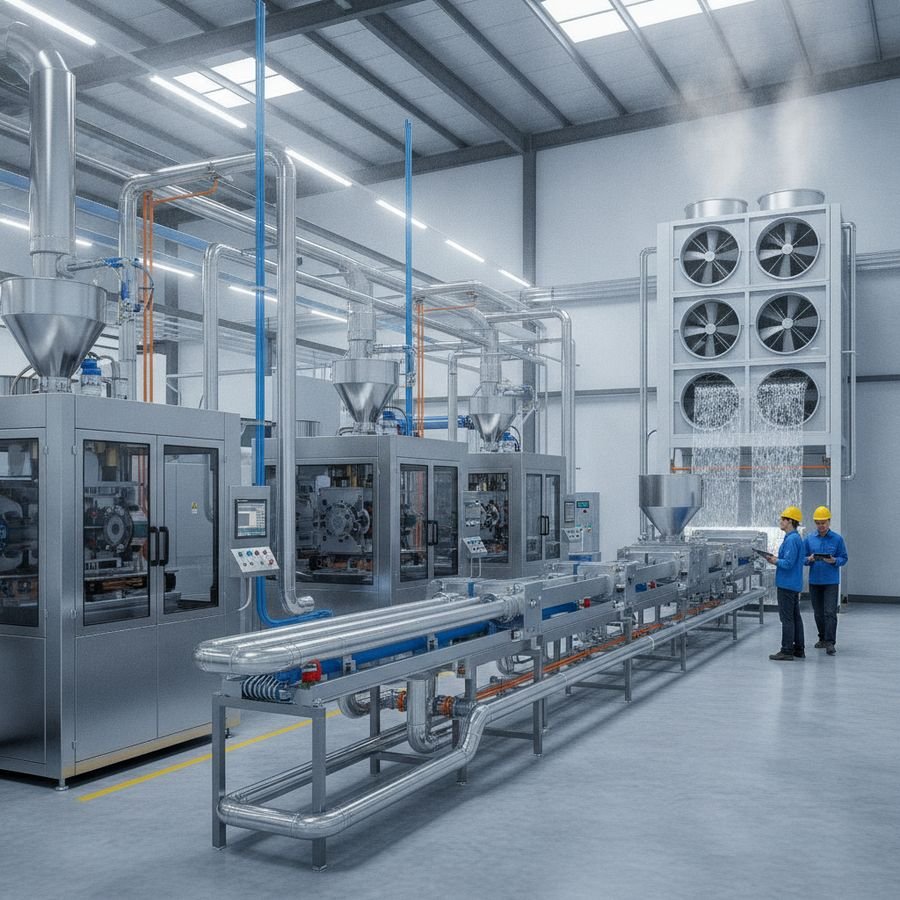
Vertical Air Discharge in Tight Plant Layouts
Plant layout is often a hidden challenge in tower selection. Plastics facilities frequently have limited outdoor clearance, nearby structures, traffic aisles, pipe racks, and roofline restrictions that complicate installation. In these conditions, vertical air discharge offers a major advantage because it helps the tower operate with less dependence on wind direction and surrounding obstructions.
According to the product information provided for Frimec’s TRA series, the design was developed to allow maximum flexibility for positioning. That matters in crowded plants where every meter counts. By discharging air vertically, the tower can reduce performance uncertainty caused by side winds and awkward placement near walls or adjacent equipment. This makes it easier to integrate cooling towers into existing process areas without forcing a full site redesign.
For managers responsible for process cooling, that flexibility can translate into faster project execution and fewer compromises. Instead of choosing a location that is ideal only on paper, the team can select a tower layout that better reflects the physical realities of the site.
Vertical air discharge supports installation freedom while helping tower performance remain more consistent in real operating conditions.
In practical terms, this benefit supports both retrofit and expansion projects in the plastics industry cooling sector. A well-positioned evaporative cooling tower can preserve access routes, simplify piping runs, and support maintainability, all while delivering the heat rejection needed for stable production.
When Centrifugal Fans Suit Indoor Installations
Not every plastics plant can place its heat rejection equipment fully outdoors. Some facilities need to install an industrial cooling tower inside industrial premises due to space limits, architectural constraints, weather exposure concerns, or site-specific process layouts. In those cases, fan selection becomes especially important.
Frimec notes that a version with high-head centrifugal fans is available for indoor installations, allowing ducting for air supply or air recovery. This is a meaningful advantage where airflow must be directed through ducts rather than discharged freely into the surrounding environment. Unlike configurations that depend on open-air placement, centrifugal fan arrangements can better support controlled ventilation paths within the building.
For process cooling in plastics applications, this means the tower can be integrated into more complex plant designs without giving up reliable heat rejection. Ductable airflow may also help teams manage building air movement more deliberately, especially where structural elements, neighboring equipment, or safety clearances limit standard installation approaches.
-
Useful when outdoor placement is impractical
-
Supports ducted air supply or recovery layouts
-
Helps adapt the tower to constrained industrial interiors
-
Expands design options for retrofit projects
Indoor tower installations require airflow control, and centrifugal fans provide the pressure capability that many ducted applications need.
For processors focused on uptime, the right fan configuration can be the difference between a workable concept and a dependable long-term solution. In plastics industry cooling, adaptability is often just as valuable as nominal cooling capacity.
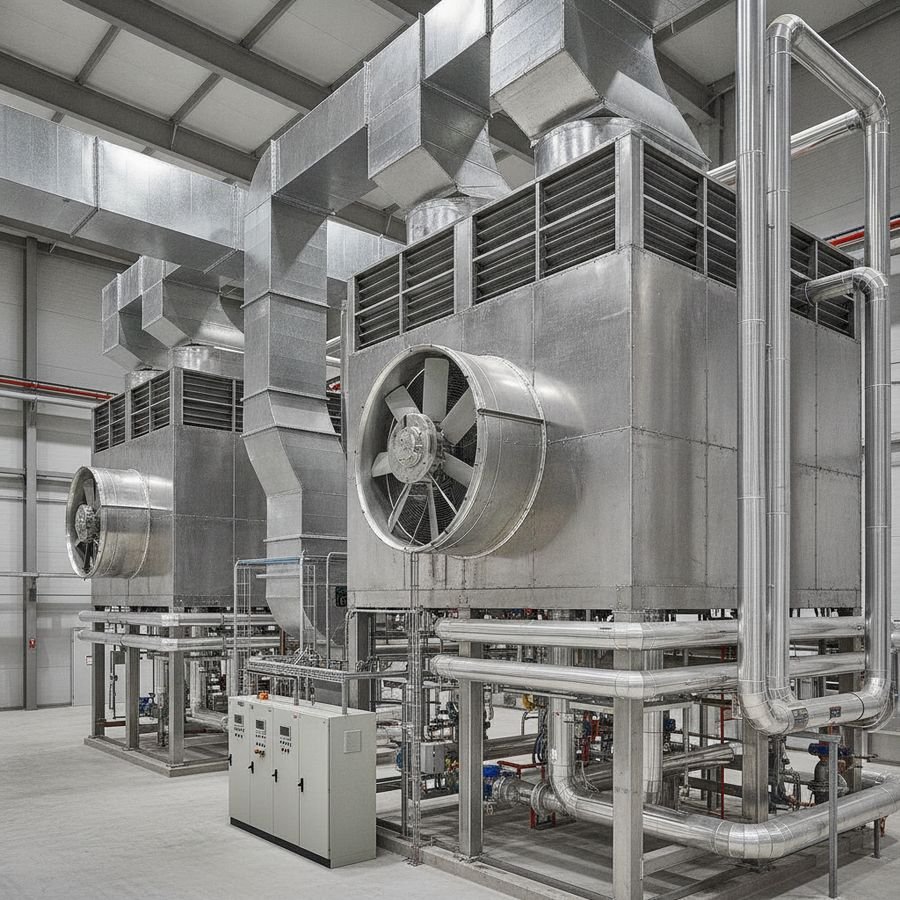
Corrosion Protection for Outdoor Tower Durability
Outdoor equipment in industrial settings is constantly exposed to moisture, temperature swings, airborne contaminants, and seasonal weather stress. For that reason, durability should never be treated as a secondary feature in cooling towers. It is a core part of life-cycle performance, maintenance planning, and long-term return on investment.
Frimec highlights that its TRA evaporative cooling tower range is built in high-thickness hot-dip galvanized sheet and further protected by suitable paints. That layered approach matters because corrosion protection helps preserve the tower structure in demanding outdoor environments. In practical terms, better resistance to atmospheric agents can reduce premature deterioration, support safer operation, and help maintain the value of the installed asset.
The same attention extends to critical components: electric motors and fan supports are described as watertight and specially executed for outdoor installation. For plastics plants, this helps align the tower with the realities of year-round exposure and continuous thermal duty. A robust design can also reduce disruption linked to avoidable component failures.
Weather resistance is not just about surviving the elements; it is about protecting uptime in a plant that depends on continuous process cooling.
When evaluating an industrial cooling tower for plastics industry cooling, buyers should look beyond initial capacity figures and consider materials, protective finishes, and component sealing. These details influence how well the system performs after years of outdoor service, not just on the day it is commissioned.
Capacity Control Dampers for Variable Loads
Heat rejection demand in plastics production is rarely constant. Load profiles shift with mold changes, resin temperatures, start-ups, partial line operation, and production scheduling. A cooling system that cannot respond efficiently to those variations may waste energy or struggle to hold stable conditions when demand changes quickly.
That is why capacity control dampers can be valuable in the right tower configuration. Frimec specifies that, in the version with centrifugal fans, towers can be supplied with dampers installed on the mouth of each fan, with a common drive shaft for each fan section. This gives operators a practical tool to better match tower operation to variable thermal loads.
For process cooling, modulation helps balance performance and efficiency. Instead of treating every operating hour as a peak-load event, the system can be adjusted to suit actual conditions more closely. In plastics plants, that can support steadier water temperatures and potentially reduce unnecessary mechanical stress on associated equipment.
-
Better alignment between cooling output and real process demand
-
Potential energy savings during partial-load operation
-
More refined control in changing production scenarios
-
Improved support for stable process temperatures
Variable-load operation is common in plastics manufacturing, so controllable tower capacity can be a practical operational advantage.
As part of a broader industrial cooling tower strategy, control features such as dampers help turn basic heat rejection into a more responsive utility. That responsiveness can support both product consistency and plant-wide efficiency goals.
Winter Defrosting Options for Year-round Uptime
Cooling equipment must perform effectively year-round, not just during warm weather. In colder climates or low-ambient periods, tower owners should consider risks like freezing, control stability, and the protection of water-carrying components. For plastics processors operating year-round, ensuring winter readiness directly contributes to uptime.
Frimec offers towers equipped with winter defrosting heaters, as well as options like an electric pump for cooling-water circulation and an electrical command and control panel. These enhancements create a more comprehensive operating package, especially where seasonal conditions might disrupt reliable process cooling. Instead of treating winter operation as an afterthought, systems can be designed with protective features from the outset.
For the plastics industry cooling sector, this is crucial, as shutdowns due to freezing or inadequate cold-weather control can halt production, delay deliveries, and incur unnecessary maintenance costs. A properly specified evaporative cooling tower should be prepared for low-temperature operations without requiring operators to resort to temporary solutions.
Year-round uptime hinges on proactive planning for winter conditions before they escalate into emergencies.
When assessing cooling towers, plant teams should not only review summer design performance but also analyze how the system will function during cold starts, low-load periods, and freezing weather. A tower designed with seasonal resilience in mind safeguards productivity throughout the entire operating calendar.
