


Overview
Cooling towers are a critical part of many plastics plants because molding, extrusion, and auxiliary equipment all depend on reliable heat rejection. In plastics processing, excess process heat must be removed consistently to protect product quality, avoid dimensional variation, and support efficient machine uptime. When a plant’s cooling loop is unstable, the effects often show up quickly as longer cycles, warped parts, and inconsistent finish.
An industrial cooling system for plastics applications must be selected with both process performance and plant conditions in mind. Operators need to evaluate thermal load, ambient climate, water quality, space limitations, and maintenance access. They also need to consider whether the tower will serve injection molding machines only or a wider network that includes extruders, hydraulic systems, compressors, and central thermoregulation equipment.
In plastics manufacturing, thermal stability is not a luxury feature; it is a production requirement tied directly to quality and throughput.
Modern evaporative solutions are especially attractive because they combine efficient heat rejection with flexible installation options. As highlighted by Frimec’s tower offering for plastics applications, an evaporative cooling tower can be configured for outdoor exposure or adapted for indoor use when the plant layout requires it. The result is a practical, energy-conscious approach to continuous cooling in demanding production environments.
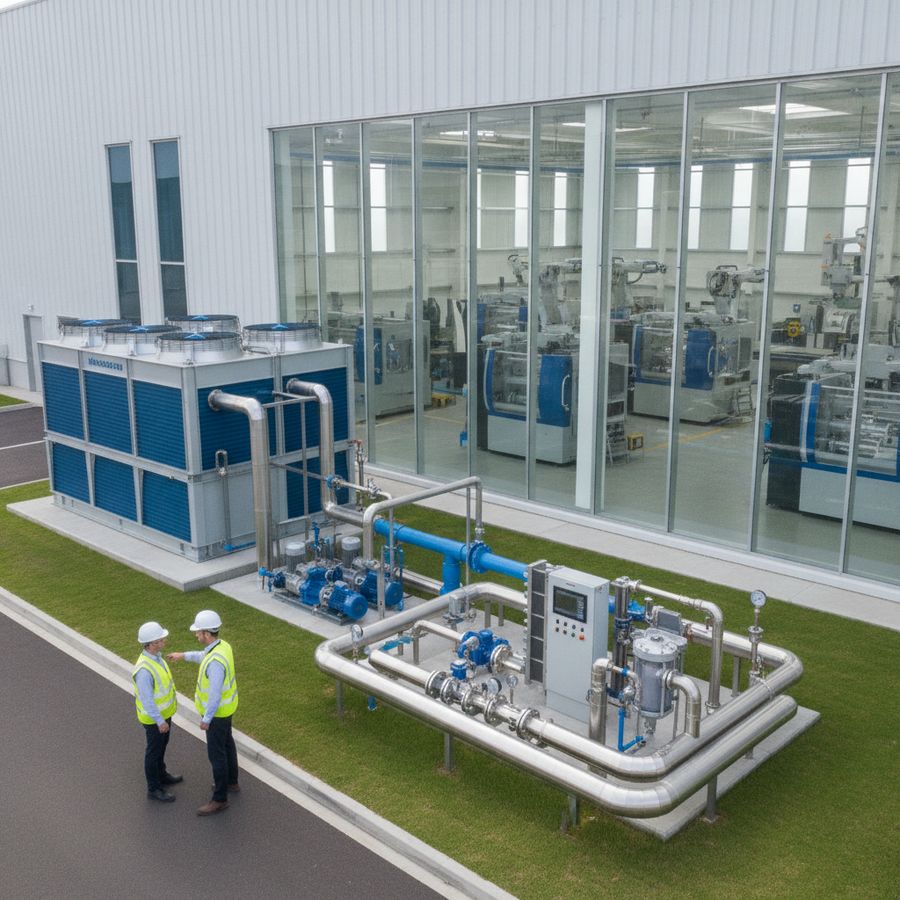
Cooling Tower Types Used in Plastics Processing
Plastics facilities can use different tower configurations, but the most common choice is the evaporative cooling tower because it delivers strong heat rejection with favorable operating efficiency. Evaporative designs cool recirculating water by combining air movement with evaporation, making them well suited to high-load, continuous-duty applications such as injection molding, blow molding, and extrusion.
Within this category, plants often compare axial-fan and centrifugal-fan arrangements. Axial-fan models are typically used in open outdoor areas where low static pressure is acceptable. Centrifugal-fan systems, by contrast, are valuable when air must be ducted or when the tower is installed inside a building. Frimec’s TRA series reflects this flexibility, using vertical air discharge to reduce sensitivity to wind direction and offering high-head centrifugal fans for indoor applications.
- Open evaporative towers for central plant heat rejection
- Centrifugal fan towers for indoor or ducted installations
- Packaged tower systems with pump and controls for simpler integration
The best option depends on the production mix, utility layout, and environmental conditions. In most plastics processing operations, the right tower type is the one that matches real process loads while maintaining straightforward access for cleaning, inspection, and seasonal adjustment.
Water Temperature Control for Stable Molding Cycles
Water temperature control is one of the most important performance factors in plastics molding. A few degrees of variation in cooling water can change mold surface temperature, affect resin shrinkage behavior, and alter cycle time. That is why the cooling tower should never be viewed as a standalone utility asset; it is part of the full process-control strategy.
For stable molding cycles, plants need a cooling loop that can respond smoothly to changing production demand. During peak operation, several machines may call for cooling simultaneously, while shift changes or product changeovers can reduce demand suddenly. A properly controlled tower, working together with pumps, valves, and thermoregulation units, helps keep supply water within the target band and reduces process drift.
Consistent part quality usually starts with consistent cooling water, especially in high-cavity molding and tight-tolerance production.
Good control also requires attention to distribution and return temperatures across the plant. If one circuit is overcooled and another is starved, the problem may appear to be a molding issue when it is really a system-balance issue. Selecting cooling towers with appropriate fan control, optional dampers, and coordinated circulation equipment helps plastics plants maintain repeatable conditions, improve scrap rates, and support predictable production scheduling.
Evaporative Cooling Tower Sizing for Plant Loads
Correct sizing is essential when selecting an evaporative cooling tower for a plastics plant. Undersized equipment can struggle during hot weather or high-output periods, leading to elevated water temperatures and unstable processing. Oversized equipment may increase capital cost, consume unnecessary space, and operate inefficiently at part load if controls are not well matched.
To size the tower properly, engineers should calculate the total plant heat load rather than focusing on a single machine. That includes molds, extruders, hydraulic circuits, compressors, and any associated process cooling loads connected to the loop. They must also consider entering water temperature, desired leaving water temperature, local wet-bulb conditions, future expansion, and the diversity factor between machines that do not peak at the same time.
- Total connected thermal load and realistic simultaneous demand
- Seasonal ambient wet-bulb temperature
- Required approach and range
- Allowance for production growth or new molding cells
A thoughtful sizing study produces more than a nameplate capacity figure. It supports better fan staging, pump selection, and control stability across varying operating conditions. For an industrial cooling system in plastics processing, accurate sizing is the foundation for long-term efficiency and dependable temperature performance.
Indoor Installation with Centrifugal Fan Systems
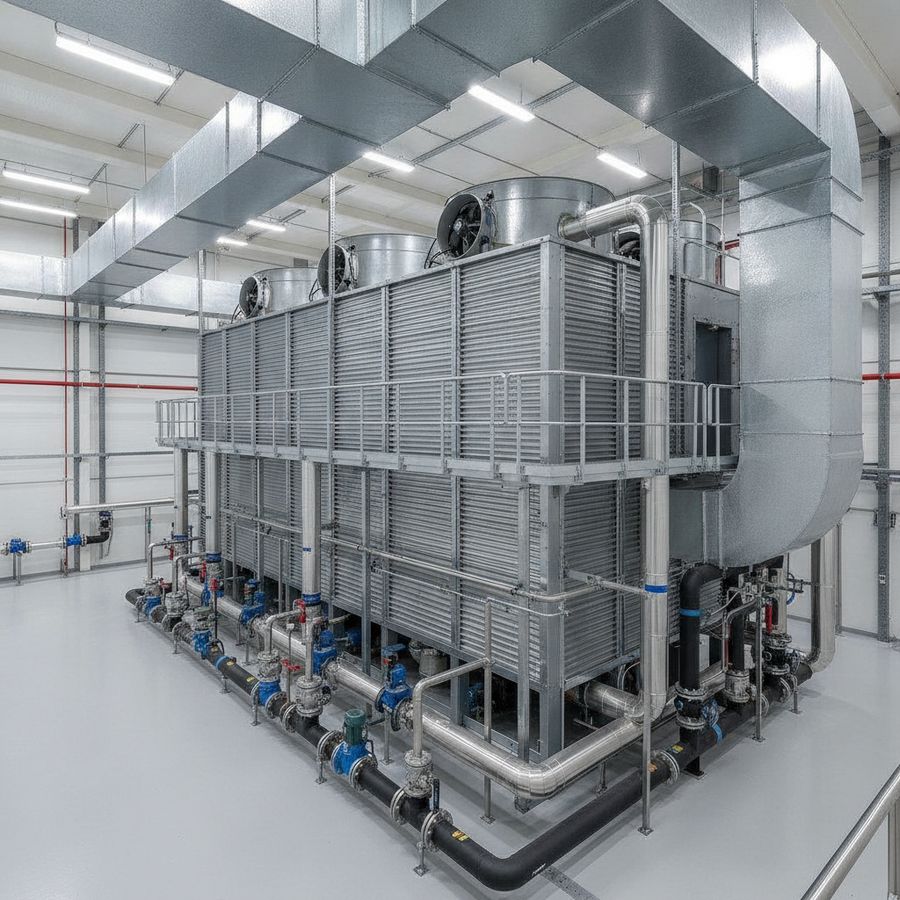
Not every plastics plant has the outdoor space or layout freedom needed for conventional tower placement. In those cases, indoor installation can be a practical solution, provided the tower is designed for ducted airflow and static pressure management. This is where centrifugal fan systems offer a clear advantage over standard low-pressure arrangements.
Frimec’s product information specifically notes that towers can be supplied with high-head centrifugal fans for installation inside industrial premises. This configuration allows ducting for either air supply or air recovery, helping engineers integrate the tower into enclosed plant layouts. For processors operating in dense industrial zones or retrofitted buildings, that flexibility can simplify project planning without sacrificing thermal performance.
Indoor placement does require careful design review. Ventilation paths, moisture management, service access, noise expectations, and structural support must all be checked before installation. In addition, operators should verify how air discharge and recirculation risks will be handled so the tower continues to perform as intended.
Indoor tower installations succeed when airflow is engineered, not improvised.
When executed properly, a centrifugal-fan industrial cooling system gives plastics manufacturers a compact, adaptable answer for sites where outdoor positioning is limited or operationally inconvenient.
Maintenance Priorities for Long Service Life
Even the best-designed cooling towers will lose performance if maintenance is neglected. In plastics plants, continuous operation, airborne dust, and varying water quality can gradually reduce heat-transfer efficiency and increase mechanical wear. A preventive maintenance plan is therefore essential for preserving capacity, lowering energy use, and extending service life.
Routine priorities should include inspection of fill media, basin cleanliness, fan assemblies, motors, spray distribution, drift control components, and water treatment effectiveness. Frimec emphasizes durable construction features such as hot-dip galvanized sheet metal, protective coatings, and watertight motors and fan supports for outdoor use. Those design advantages improve resistance to atmospheric agents, but they still perform best when paired with regular inspection and timely servicing.
- Monitor scaling, fouling, and biological growth
- Check fan and motor condition for vibration or imbalance
- Inspect pumps, piping, and nozzles for restricted flow
- Review seasonal items such as winter defrosting heaters where applicable
Maintenance should also include operational review, not just physical cleaning. Tracking leaving-water temperature, approach, fan cycling, and makeup-water trends can reveal declining performance early. For any evaporative cooling tower serving plastics processing, disciplined maintenance protects both equipment life and production consistency.
Conclusion
Selecting the right tower for a plastics plant involves more than choosing a nominal capacity. Decision-makers need to balance thermal load, process sensitivity, installation constraints, airflow requirements, material durability, and maintenance strategy. When these factors are reviewed together, the resulting system supports better production quality and fewer operating surprises.
For many facilities, an evaporative cooling tower remains the most efficient and practical answer for central heat rejection. It is especially effective when paired with strong water temperature control, correct sizing, and an installation layout matched to the realities of the site. In plants with limited outdoor options, centrifugal-fan configurations can add valuable flexibility while preserving dependable cooling performance.
The best cooling solution for plastics manufacturing is the one that keeps temperatures stable, adapts to the plant layout, and remains serviceable over the long term.
Frimec’s focus on tailor-made industrial refrigeration and temperature control aligns well with the needs of modern plastics manufacturers. From weather-protected construction to optional pumps, controls, dampers, and defrosting features, the right industrial cooling system can be configured to match demanding production environments. In short, careful selection of cooling towers is a direct investment in cycle stability, equipment reliability, and plant-wide efficiency.
