


Why Plastics Lines Need Stable Cooling
In plastics processing, stable cooling is not a secondary utility; it directly affects cycle time, dimensional accuracy, surface finish, and scrap rates. Injection molding, extrusion, blow molding, and thermoforming all depend on predictable heat removal from molds, barrels, hydraulic circuits, and auxiliary equipment. When cooling water temperature drifts, the result is often visible on the product line first: warpage, sink marks, inconsistent gloss, or unstable part weights. That is why properly selected cooling towers remain central to efficient plastics cooling strategies.
A cooling system that is undersized or poorly controlled forces production teams to compensate elsewhere. Operators may slow throughput, widen process windows, or accept higher reject levels just to keep production moving. In a high-volume plant, even a small rise in cooling water temperature can increase cycle times enough to create a meaningful loss in output over a shift.
For plastics plants, cooling stability is production stability: temperature control protects both product quality and machine performance.
This is where an evaporative cooling tower becomes valuable within broader industrial refrigeration planning. A well-sized tower can reject process heat efficiently while supporting consistent return-water temperatures across varying ambient conditions. For plants with multiple machines and changing loads, the real objective is not simply cold water, but repeatable thermal performance. Good cooling tower sizing helps ensure that molds, process equipment, and recirculation loops all operate inside the temperature range the process was designed for.
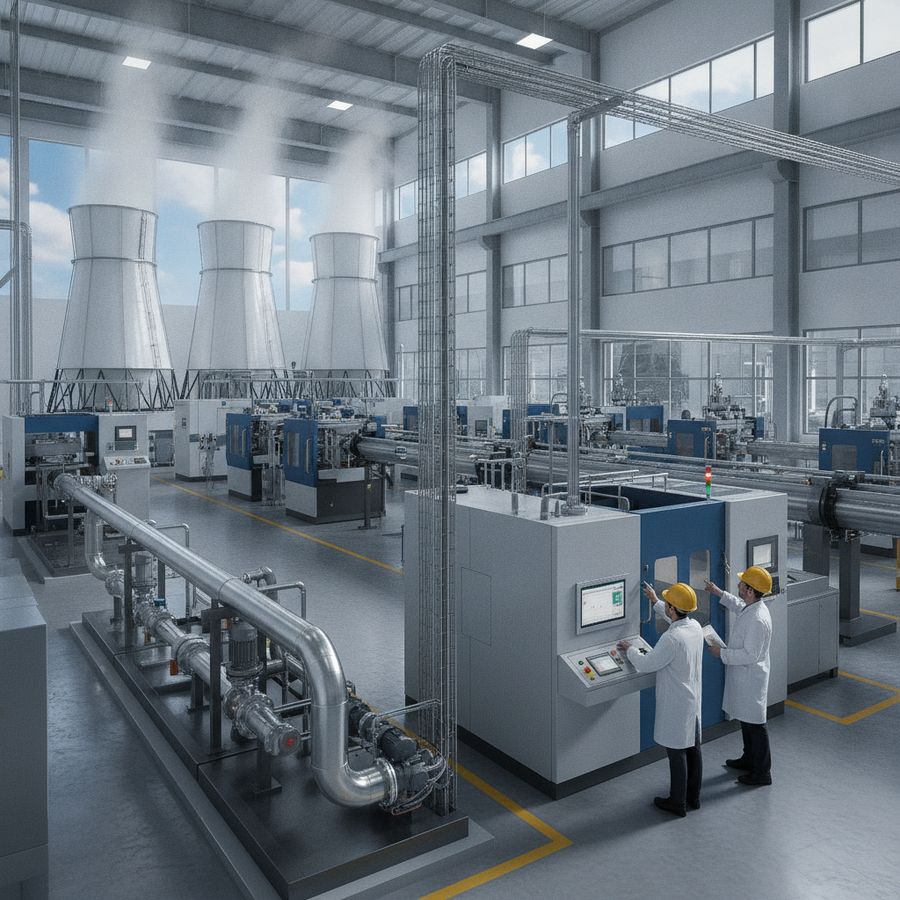
Heat Load Data Engineers Must Collect
Accurate cooling tower sizing begins with disciplined heat-load collection. Too often, towers are selected from rough machine totals or nameplate assumptions, but plastics lines rarely run at identical conditions all day. Engineers need real operating data from molding machines, extruders, dryers, hydraulic systems, condensers, and any auxiliary loops connected to the water circuit. The goal is to define the actual heat rejection requirement, not a theoretical maximum that leads to oversizing or an optimistic estimate that causes summer performance problems.
The most important inputs usually include process flow rate, entering and leaving water temperature, peak and average production schedules, ambient wet-bulb design conditions, and equipment diversity. In plastics facilities, one production area may run continuously while another cycles by shift or product type. That variation matters because tower performance should match both peak demand and realistic operating profiles.
- Total process heat load in kW or kcal/h
- Water flow rate for each machine or loop
- Required cold-water supply temperature
- Expected hot-water return temperature
- Local summer wet-bulb temperature
- Future expansion margin for added lines
Frimec emphasizes tailor-made industrial refrigeration, and that approach is especially useful here. Reliable design also considers pumping head, fouling allowance, standby needs, and whether some loads are better separated into different loops. With complete data, engineers can select cooling towers that meet present demand without wasting fan power, water, or floor space. Good data collection is the foundation of dependable plastics cooling.
Open Loop Versus Closed Loop Choices
Choosing between an open loop and a closed loop arrangement is one of the most important decisions in industrial refrigeration for plastics plants. In an open-loop system, process water circulates directly through the evaporative cooling tower, where it contacts air and rejects heat by evaporation. This configuration is efficient and often cost-effective, especially for large centralized loads. However, because the water is exposed to the atmosphere, it also faces higher contamination, scaling, and biological risk.
A closed loop keeps process fluid isolated inside a heat exchanger or coil, while tower water operates on a separate circuit. This setup generally offers better protection for molds, process channels, and sensitive equipment. Closed configurations are often preferred where water cleanliness is critical, where small passages can foul easily, or where uptime penalties from maintenance are high.
The lower first cost of an open loop can be offset quickly if poor water quality increases downtime, cleaning frequency, or product inconsistency.
The right choice depends on plant priorities:
- Open loop: strong thermal efficiency, simpler layout, lower initial cost for many applications
- Closed loop: cleaner process circuit, lower fouling risk, better protection for valuable equipment
- Hybrid approach: separate loops for robust utility loads and precision process loads
For plastics processors, the decision should be based on maintenance resources, water chemistry, machine sensitivity, and required temperature stability. A supplier experienced in cooling tower sizing can help compare lifecycle cost, not just purchase price. In many plants, the most economical solution over time is the one that keeps process temperatures stable while reducing service interruptions.
Airflow Placement and Wind Exposure Limits
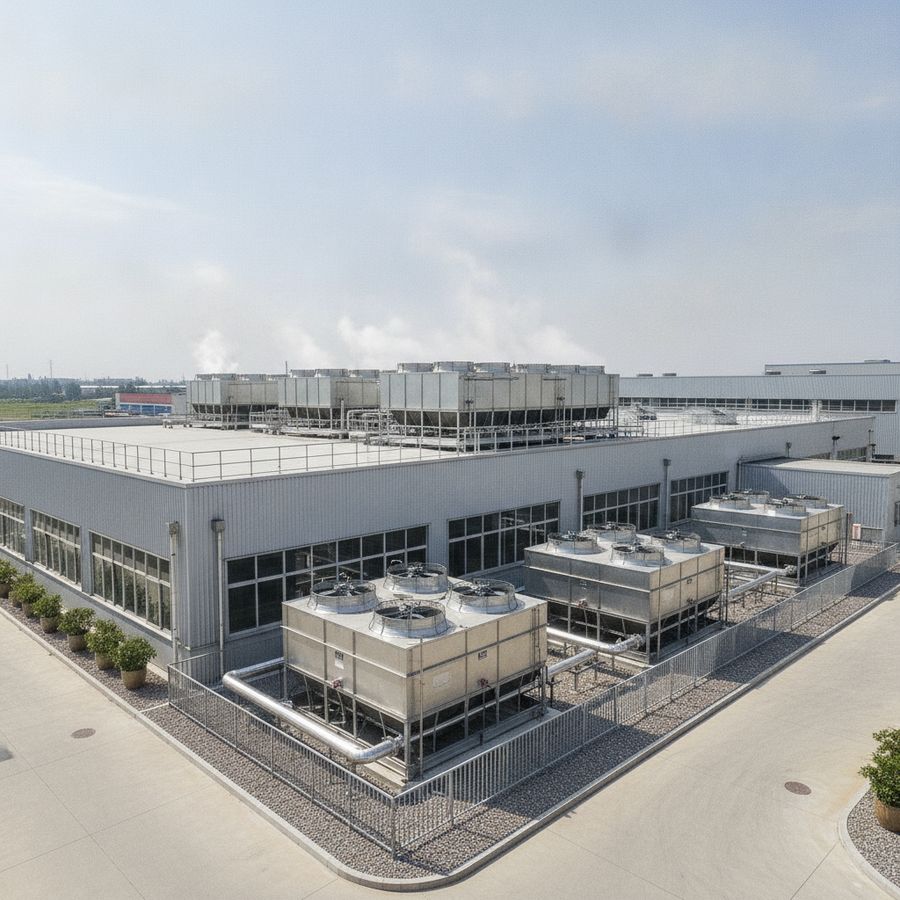
Tower location has a major impact on real-world performance. Even correctly sized cooling towers can underperform if installed where airflow is restricted, hot discharge air recirculates, or nearby structures create turbulent wind patterns. Plastics plants often expand in stages, and towers may end up squeezed beside walls, process buildings, or roof edges that were never intended for thermal equipment. That is why placement must be evaluated as part of cooling tower sizing, not after equipment procurement.
Frimec notes that its TRA series uses vertical air discharge, a design intended to make operation largely independent of wind direction and intensity. That is especially valuable outdoors, where changing winds can otherwise reduce draft stability and promote recirculation. For installations inside industrial premises, versions with high-head centrifugal fans can support ducted air supply or recovery, which helps where free discharge is not possible.
Engineers should review several placement factors before finalizing a layout:
- Clearance from walls, roofs, and adjacent towers
- Risk of warm saturated discharge re-entering air intakes
- Prevailing wind exposure and turbulence around structures
- Maintenance access for fans, fill, motors, and basins
- Noise constraints and drift considerations near occupied areas
Wind alone is not always the problem; poor air path design is often the real cause of lost capacity. A tower that breathes freely will usually deliver more stable plastics cooling than a larger unit trapped in a bad location. Proper siting protects efficiency, keeps approach temperatures realistic, and reduces the risk of summer shortfall when production demand is highest.
Water Quality Risks in Tower Performance
Water quality is one of the most underestimated factors in tower reliability. In an evaporative cooling tower, evaporation concentrates dissolved minerals, suspended solids, and treatment byproducts over time. If chemistry is not controlled, scale forms on heat-transfer surfaces, corrosion attacks metal components, and biological growth reduces flow and hygiene. For plastics plants, these issues do not stay inside the tower; they travel downstream into heat exchangers, molds, condensers, and piping where performance losses become expensive.
Even a thin scale layer can reduce heat transfer enough to raise process-water temperature and destabilize molding or extrusion conditions. Corrosion products can clog narrow passages, while slime and biofilm can increase pump energy and create uneven distribution across the fill. The result is declining tower efficiency, more cleaning shutdowns, and greater stress on the overall industrial refrigeration system.
Consistent water treatment is not optional maintenance; it is a capacity-preservation strategy.
Best practice usually includes a combination of filtration, chemical treatment, conductivity control, and routine monitoring. Plants should track hardness, alkalinity, pH, cycles of concentration, suspended solids, and microbiological activity. Material selection matters too. Frimec highlights galvanized steel construction with protective coatings for atmospheric durability, but all tower materials still benefit from proper chemistry management.
For long-term cooling tower sizing, engineers should account for the fact that untreated systems rarely perform like clean design conditions. Water quality discipline protects thermal capacity, extends equipment life, and supports the temperature consistency that successful plastics cooling demands.
Capacity Control Options for Variable Demand
Plastics plants rarely operate at one constant load. Product changeovers, shift patterns, seasonal ambient changes, and machine staging all create swings in heat rejection demand. A tower selected only for peak conditions may still waste energy or allow temperature fluctuation if it cannot modulate effectively at part load. That makes capacity control an essential part of modern cooling tower sizing.
The simplest control method is fan cycling, which turns one or more fans on and off to maintain leaving-water temperature. This works well in many applications, but frequent cycling can increase wear if controls are not tuned properly. More refined options include variable-speed fans, multi-cell staging, basin heaters for winter operation, and control dampers where tower configuration allows them. Frimec specifically notes the availability of a capacity control damper on versions with centrifugal fans, along with winter defrosting heaters and integrated pump/control options.
- Fan on/off staging: economical and widely used
- Variable speed control: better temperature stability and lower energy use
- Multi-cell sequencing: matches active tower area to load
- Dampers and winter accessories: useful for cold-weather and ducted installations
The best control strategy balances temperature precision, mechanical simplicity, and maintenance expectations. In plastics cooling, tighter water control can improve cycle repeatability and reduce process drift during partial production. When paired with sound system design, smart capacity control turns cooling towers from a basic utility into a responsive, energy-aware asset within the plant’s broader industrial refrigeration infrastructure.
