


Overview
Cooling towers for wind-exposed industrial sites must do more than reject heat efficiently. They also need to maintain stable performance when weather conditions change, installation space is limited, and production demands remain constant. In sectors such as plastics, electroplating, food processing, and other heavy-duty applications, a properly designed industrial cooling tower helps protect equipment, stabilize process temperatures, and support long-term operating efficiency.
An evaporative cooling tower works by transferring unwanted process heat to the atmosphere through the evaporation of a small portion of circulating water. While this principle is well known, tower performance can vary significantly depending on airflow design, materials, fan configuration, and site exposure. Wind, rain, seasonal temperature swings, and airborne contaminants all influence reliability, especially in outdoor industrial environments.
For facilities exposed to strong crosswinds, tower positioning flexibility becomes a major advantage. Systems designed with vertical air discharge can operate more independently from wind direction and intensity, helping maintain thermal performance even when conditions outside are less predictable. This matters for plants that cannot afford frequent process interruptions or unstable cooling capacity.
At demanding industrial sites, cooling tower design is not only about heat rejection capacity, but also about operational stability in real installation conditions
Modern cooling towers may also be configured for indoor use, corrosion resistance, capacity modulation, and winter operation. These features allow manufacturers to align heat rejection equipment with both plant layout and year-round production needs, creating a more dependable and adaptable cooling solution.

Why Vertical Air Discharge Improves Stability
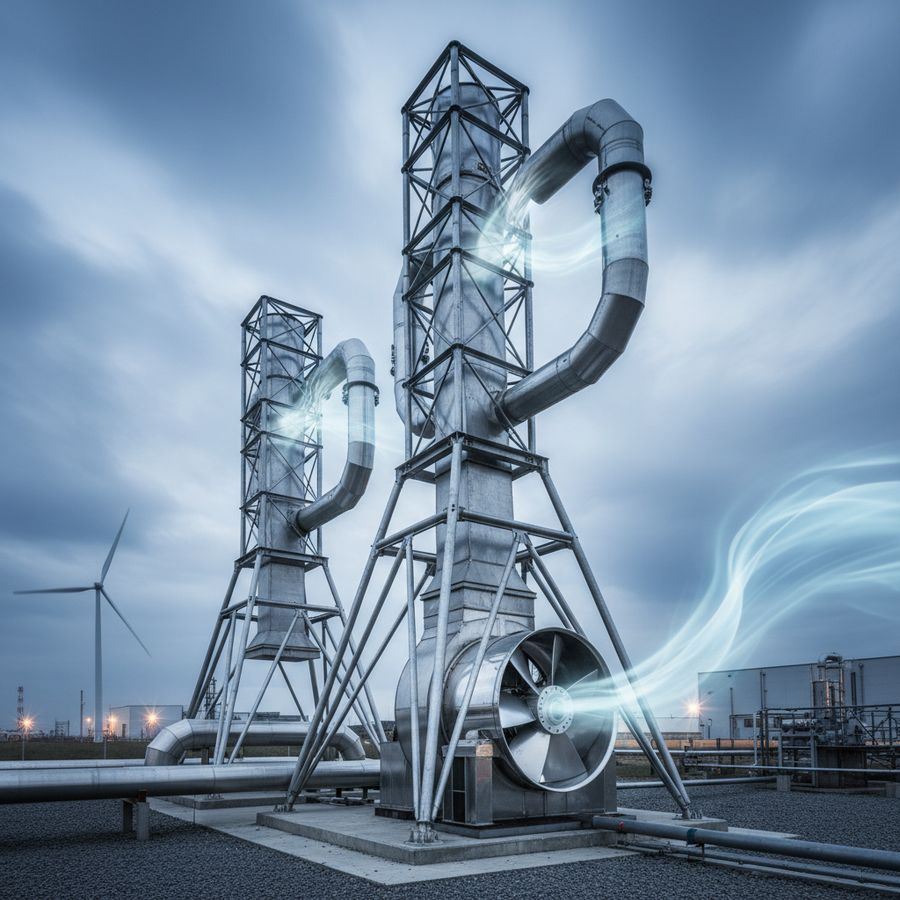
In wind-exposed environments, airflow management is critical to consistent tower operation. A tower with vertical air discharge releases air upward rather than laterally, reducing the influence of crosswinds on the discharge pattern. This design helps the evaporative cooling tower maintain steadier thermal behavior, even when wind direction shifts throughout the day.
When horizontal or poorly directed discharge meets strong external air currents, performance can suffer from recirculation, reduced draft efficiency, and uneven heat rejection. Vertical discharge minimizes these risks by sending warm, moisture-laden air away from the intake zone in a more controlled path. For industrial sites with open yards, rooftops, or perimeter installations, that stability can make a measurable difference in process cooling consistency.
Another important benefit is installation flexibility. According to the product information provided, this configuration allows tower functioning to remain largely independent of wind direction and intensity. That means plant designers have greater freedom in placing the industrial cooling tower where it best suits piping, maintenance access, and production flow, rather than choosing a location based only on prevailing wind concerns.
- Improves resistance to changing wind conditions
- Helps reduce airflow disturbance and recirculation
- Supports more predictable cooling performance
- Allows greater flexibility in tower placement
For facilities seeking dependable heat rejection under challenging outdoor conditions, vertical air discharge is a practical engineering feature that supports reliable, all-season operation.
Outdoor Materials That Resist Corrosion and Weather
Outdoor industrial environments can be harsh on thermal equipment. Moisture, airborne chemicals, UV exposure, temperature changes, and wind-driven debris all accelerate wear if the tower is not built with suitable materials. That is why material selection is a key factor when specifying cooling towers for long-term industrial use.
The referenced tower design highlights construction in high-thickness hot-dip galvanized sheet, further protected with suitable paints. This approach creates a strong barrier against atmospheric agents and helps preserve structural integrity over time. In an industrial cooling tower, corrosion protection is especially important because the unit continuously operates in a humid environment where metal surfaces are regularly exposed to water and air.
Protection should not stop at the casing. Outdoor reliability also depends on components such as electric motors and fan supports. Watertight motors and specially executed fan supports are highly relevant for installations exposed to rain, splash, and demanding weather. These details improve resilience and reduce the risk of premature component failure in external applications.
Durable construction is one of the most important factors in preserving cooling tower efficiency and reducing lifecycle maintenance costs
For many industrial operators, weather resistance translates directly into lower downtime and more predictable maintenance planning. A robust evaporative cooling tower built for outdoor exposure can better withstand real operating conditions while continuing to deliver process cooling where reliability matters most.
In short, corrosion-resistant materials are not an optional upgrade for exposed sites. They are a foundational requirement for dependable performance, equipment longevity, and total cost control.
Centrifugal Fans for Indoor Tower Ducting
Not every cooling tower is installed outdoors in an open yard. Some industrial facilities need tower placement inside production buildings, service rooms, or partially enclosed utility areas. In these cases, airflow cannot simply be released into the surrounding space. The system must manage supply or recovery air through ductwork, and this is where centrifugal fans become especially valuable.
High-head centrifugal fans are well suited for ducted applications because they can overcome the additional resistance created by air channels, bends, and exhaust routing. This enables the industrial cooling tower to operate effectively even when air must be conveyed to or from a specific location. For indoor installations, that capability expands design options without sacrificing the thermal benefits of evaporative cooling.
Using ductable fan arrangements can also help improve plant integration. Engineers may direct discharge air away from occupied zones, coordinate ventilation paths, or recover air according to building layout requirements. This is particularly useful in industrial premises where available space is limited or where outdoor placement is not ideal.
- Supports installation inside industrial premises
- Allows air supply or recovery through ducting
- Handles higher static pressure than standard fan arrangements
- Improves flexibility in plant layout planning
When properly matched to the building environment, centrifugal fans help maintain efficient tower performance while solving practical airflow challenges. For manufacturers seeking indoor heat rejection solutions, this configuration offers a reliable path to integrating an evaporative cooling tower into complex industrial spaces.
Capacity Control Dampers and Seasonal Operation
Industrial heat loads rarely remain constant throughout the year. Production shifts, ambient temperature changes, and varying process demand all affect how much cooling capacity is needed at any given time. For this reason, cooling towers that offer adaptable control features can deliver better efficiency and more precise operation across seasons.
One useful option is the capacity control damper, especially in versions equipped with centrifugal fans. Installed at the mouth of each fan, with a common drive shaft for each section, these dampers help regulate airflow and align tower performance with actual cooling demand. Rather than operating at a single fixed condition, the industrial cooling tower can respond more effectively to process variations.
Seasonal readiness also matters in colder climates or during winter production schedules. Optional accessories such as electric control panels, circulation pumps, and winter defrosting heaters can support stable operation when low ambient temperatures create icing or freezing risks. This helps facilities avoid disruption while keeping process cooling available during colder months.
Capacity control and winter protection features help transform a cooling tower from a seasonal asset into a year-round industrial utility
Operational flexibility can provide several practical benefits:
- Better matching of cooling output to real demand
- Reduced operational stress during partial-load periods
- Improved control in transitional weather conditions
- Safer operation during winter or cold-start scenarios
For plants that need dependable performance across changing operating conditions, these control and protection features make an evaporative cooling tower more efficient, resilient, and easier to manage.
Conclusion
Selecting the right cooling towers for wind-exposed industrial sites requires a careful balance of thermal performance, structural durability, and installation flexibility. Facilities operating in demanding sectors need more than standard heat rejection equipment. They need systems that continue performing reliably in real-world conditions shaped by wind, weather, layout constraints, and changing production loads.
A well-designed evaporative cooling tower can answer these challenges through features that directly support operational stability. Vertical air discharge helps reduce the impact of wind direction and intensity. Corrosion-resistant, weather-protected construction improves durability in outdoor environments. High-head centrifugal fans make indoor ducted installations possible, while capacity control dampers and winter accessories extend usability across seasons.
These are not isolated benefits. Together, they create a more adaptable industrial cooling tower solution for facilities that require dependable process temperature control. Whether the application involves plastics, food production, electroplating, or other industrial operations, the right tower configuration can improve uptime, protect equipment, and support efficient plant performance over the long term.
For decision-makers evaluating heat rejection systems, the best results come from choosing equipment designed around actual site conditions rather than theoretical performance alone. In exposed industrial settings, that practical approach is what turns a cooling tower into a lasting operational advantage.
