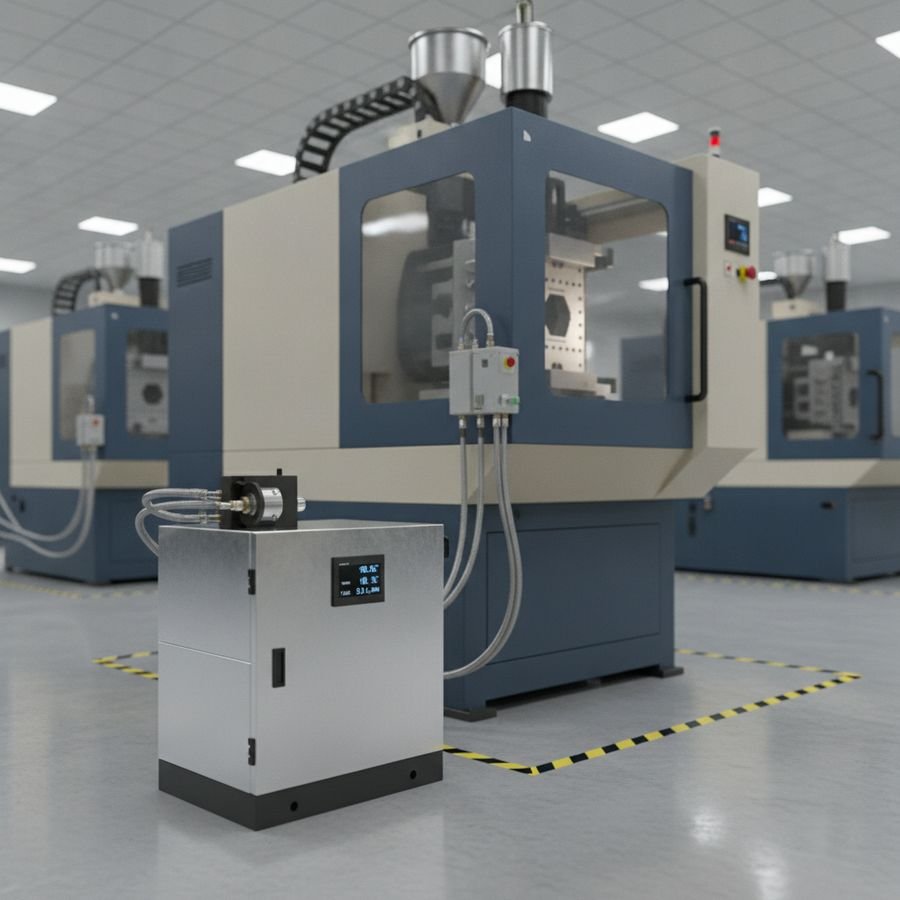


Why Plastics Processing Needs Stable Temperatures
In plastics manufacturing, temperature is not just a setting on a controller. It is a core process variable that affects cycle time, part quality, dimensional stability, and scrap rate. Whether the application is injection molding, blow molding, thermoforming, or extrusion, heat must be removed at the right speed and with the right consistency. That is why well-sized industrial chillers are central to reliable plastics cooling.
When temperatures drift, the effects show up quickly. Molds may cool unevenly, causing warpage, sink marks, or inconsistent surface finish. Extrusion lines can see variation in melt behavior, sizing, and downstream handling. Even a small fluctuation in supply water temperature can create a larger production problem when it repeats over hundreds or thousands of cycles.
Process chillers help maintain a controlled thermal window instead of allowing production to react to changing ambient conditions or shared plant loads. This matters even more in plants running multiple machines, different resins, or tight customer tolerances.
Stable cooling does more than protect product quality — it protects throughput, energy performance, and process repeatability.
For plastics processors, the goal is not simply to buy the largest unit available. It is to match cooling capacity, flow, and temperature control to the process. A chiller that is too small struggles to hold setpoint, while an oversized system can short-cycle and waste energy. Proper sizing starts with understanding where heat is generated, how it moves through the process, and how tightly temperatures must be controlled from one run to the next.
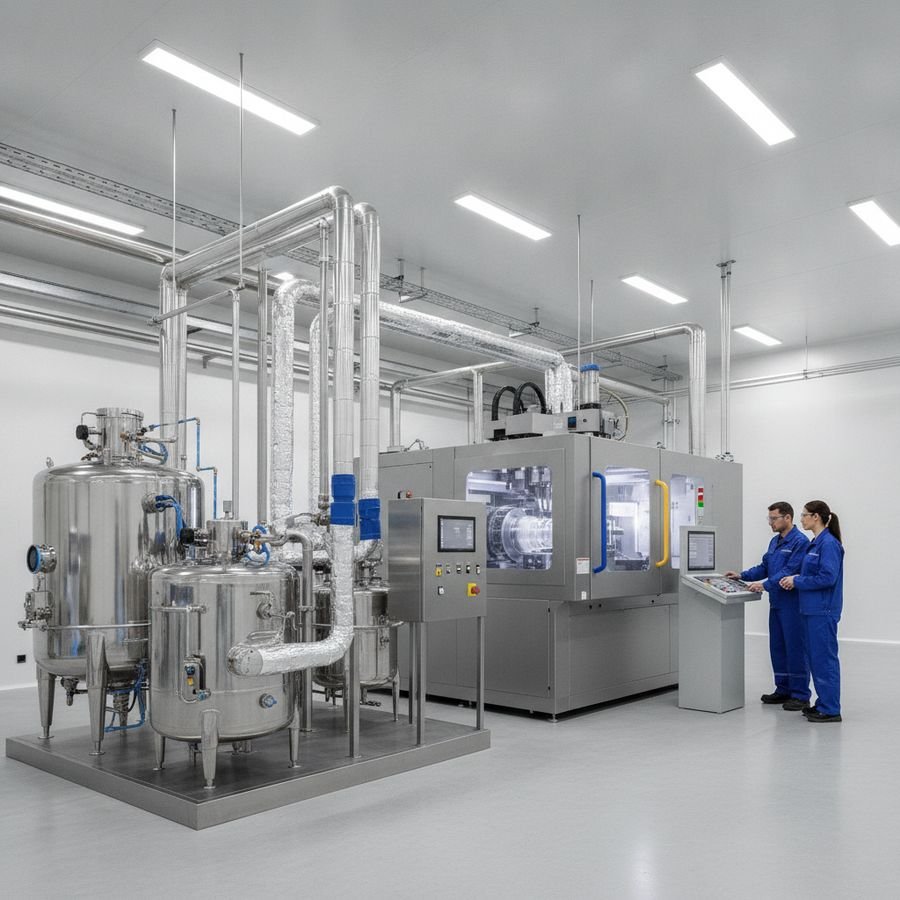
Cooling Load Data That Really Matters
Many chiller sizing mistakes begin with incomplete load information. Asking for a unit based only on machine tonnage or a rough estimate often leads to oversizing. In plastics cooling, the best decisions come from measured operating data, not assumptions. To size industrial chillers correctly, you need to understand both the peak load and the normal running load.
The most useful inputs usually include process type, resin throughput, target supply temperature, return temperature, required flow rate, ambient conditions, and operating schedule. If a plant runs several machines, it is also important to know whether they peak at the same time or cycle independently. That difference can change the required capacity significantly.
- Entering and leaving fluid temperatures
- Actual flow through molds, barrels, or heat exchangers
- Hours of operation and seasonal ambient conditions
- Future expansion plans or spare capacity needs
- Whether the load is constant, pulsing, or batch-based
For systems connected to outdoor heat rejection equipment, site conditions matter as well. Frimec’s background in industrial refrigeration and cooling towers reflects a practical reality: heat rejection performance changes with installation conditions, airflow, and water quality management.
The load that matters is the real heat removed from the process, not the nameplate size of the machine beside it.
Good load data produces better results: smaller energy waste, more stable control, and fewer surprises after installation. Before choosing between process chillers, collect the numbers that describe the process itself, not just the equipment around it.
Air Cooled Versus Water Cooled Chillers
Choosing between an air cooled chiller and a water cooled chiller is one of the most important decisions in plastics cooling. Both can work well, but they fit different operating environments. The right choice depends on plant layout, utility availability, climate, maintenance resources, and long-term energy priorities.
An air cooled chiller is often simpler to install because it rejects heat directly to ambient air and does not require a separate condenser water loop. For many plastics processors, that means lower installation complexity and faster deployment. Air cooled systems are especially practical where water availability is limited or where a self-contained outdoor package is preferred.
Water cooled chillers generally offer higher efficiency in demanding or continuous-duty applications, especially when paired with properly selected heat rejection equipment such as cooling towers. They can be a strong choice for larger production facilities that need centralized cooling and want better performance during hot weather. However, they also require more infrastructure and more attention to water treatment, pumps, and condenser-side maintenance.
- Air cooled chiller: easier installation, fewer water-side components, good for modular layouts
- Water cooled chiller: strong efficiency potential, suited to heavy loads, ideal for central systems
The best chiller type is the one that fits the plant as a whole — not just the refrigeration circuit alone.
Frimec’s product range across air-based units, water-condensed refrigeration units, and cooling towers reflects this broader system view. In practice, the decision should balance capital cost, operating cost, serviceability, and the stability your plastics process requires every day.
Flow Rate Mistakes That Raise Energy Use
Cooling capacity is only part of the equation. In many plastics applications, incorrect flow rate causes as much trouble as incorrect chiller size. Too little flow reduces heat transfer and creates larger temperature differences across the process. Too much flow can drive unnecessary pump energy, increase pressure losses, and still fail to improve actual cooling where it matters.
A common mistake is assuming that higher flow always means better plastics cooling. In reality, mold channels, hoses, manifolds, and heat exchangers each have practical limits. Once turbulence and heat transfer are already adequate, pushing more water through the circuit may only add electrical cost. Another frequent issue is poor balancing between multiple machines, where one circuit takes excess flow while another starves.
Well-designed process chillers should be matched with the right hydraulic design, including pump selection, pipe sizing, and distribution control. This is especially important in plants with long piping runs or centralized systems serving different temperature zones.
- Verify actual flow, not just pump nameplate performance
- Check pressure drop across molds and process circuits
- Balance branch circuits in multi-machine systems
- Avoid oversizing pumps simply to cover unknowns
Efficient cooling depends on delivering the right water volume to the right point in the process at the right temperature.
When flow is controlled correctly, industrial chillers operate more efficiently and temperature stability improves. The result is lower energy use, less process variation, and fewer situations where operators compensate for hydraulic problems by lowering chiller setpoints more than necessary.
Temperature Control for Molds and Extrusion
Not every plastics process needs the same cooling strategy. Injection molds, extrusion barrels, calibration tanks, and downstream rolls all behave differently, so the temperature control approach should reflect the job. This is where many processors move beyond simple cooling and start focusing on process-specific thermoregulation.
For molds, the objective is usually repeatable cycle performance and uniform part quality. Uneven mold temperature can lead to visible defects and inconsistent shrinkage. In these cases, industrial chillers must provide stable supply temperature while the hydraulic circuit delivers balanced flow to each zone. Some tools also benefit from dedicated temperature control units where heating and cooling must be tightly coordinated.
Extrusion brings a different set of demands. The line may include barrel zones, feed throat cooling, die temperature management, vacuum tanks, calibration tables, haul-off areas, and product-specific downstream cooling. The challenge is not just removing heat, but doing so at the correct stage and rate so the product holds shape without introducing internal stress.
Good plastics cooling is rarely one temperature everywhere; it is controlled thermal management across the full production path.
That is why processors often combine process chillers with thermoregulation equipment rather than relying on one general-purpose loop. Frimec’s emphasis on industrial thermoregulation aligns with this need for tailored control. When molds and extrusion lines receive the right temperature profile, plants gain faster startup, fewer defects, and more confidence that each run will match the one before it.
When a Microchiller Beats Central Cooling
Central cooling systems are powerful and efficient in the right environment, but they are not always the smartest solution for every plastics line. In some cases, a microchiller offers better control, lower installation complexity, and less waste. This is especially true for single machines, laboratory lines, niche production cells, or processes with unique temperature requirements.
A dedicated unit can isolate a critical load from variations elsewhere in the plant. If a central loop serves multiple machines with changing demand, one sensitive process may experience unstable supply conditions or flow competition. A microchiller avoids that problem by delivering cooling directly where it is needed, with tighter local control and shorter hydraulic paths.
There are also practical advantages during expansion. Adding a small process cell may not justify extending central piping, increasing pump capacity, or resizing the main plant. In these situations, compact process chillers can reduce project cost and speed up commissioning.
- Best for standalone machines or pilot lines
- Useful when one process needs a different setpoint
- Reduces dependence on central loop fluctuations
- Can simplify phased plant growth
Bigger cooling infrastructure is not always better; the most efficient choice is the one that matches the load with the least complexity.
For plastics processors focused on precision and flexibility, microchillers can outperform a centralized approach in both energy use and control quality. The key is to evaluate the actual application, not assume that one architecture fits every machine, mold, or extrusion line in the facility.